Registration Open 丨 SLAI and DexForce Co-Host RoboSynChallenge, World's First Synthetic Data-Driven Embodied AI Challenge
This summer, join SLAI to tackle core challenges in embodied AI and bridge the Sim2Real gap!
A robot practices pouring thousands of times in simulation, growing steadier with each attempt. Yet when the cup position, surface texture, and lighting conditions change, or when distractors appear, can it still succeed in the real world?
This captures the fundamental challenge in transferring robotic manipulation from simulation to reality: real-world data is costly and cannot cover all variations, while synthetic data, though scalable, does not always transfer directly to physical environments.
How can scalable synthetic data enable robots to truly bridge the Sim2Real gap?
This critical question now takes center stage as a global competition.
RoboSynChallenge (USD 20,000 prize pool) joins the NeurIPS 2026 Competition Track and has been open for registration since July 13.
Rather than optimizing scores on isolated tasks, the competition addresses one of the most critical and difficult problems in embodied AI: leveraging scalable synthetic data alongside limited real-world data to develop robot manipulation policies that genuinely bridge the Sim2Real gap and maintain robust performance in unseen real-world scenarios
Competition Overview
The RoboSynChallenge comprises two stages.
Stage 1: Simulation Preliminary (via Domain Randomization)
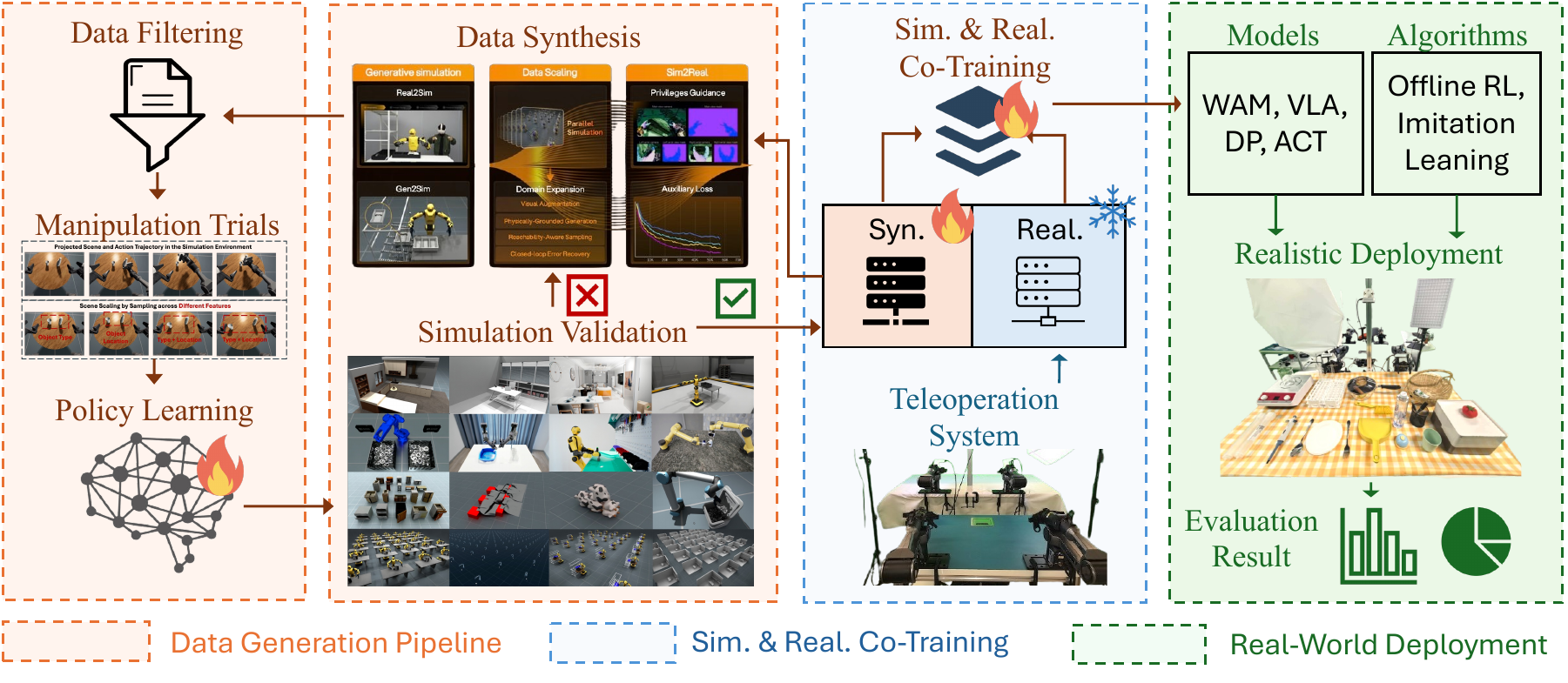
Teams primarily train policies using official simulation synthetic data. The competition also open-sources a data synthesis pipeline, enabling teams to generate and expand their own training datasets. The preliminary environment incorporates extensive domain randomization, varying lighting conditions, textures, object poses, camera viewpoints, and robot initial states, while introducing distractor objects.
(For details, please watch the official video at https://robosyn-bench.net/#/evaluation.)
Models must overcome these variations to learn manipulation policies with enhanced generalization capability, thus establishing a foundation for robust performance in real-world environments. Organizers will select finalist teams based on unified simulation evaluation results and announce the shortlist on October 18.
Stage 2: Sim2Real Final (on Physical Robots)
Finalist teams may update their models from October 18 to November 15, incorporating joint training with limited real robot demonstrations. Submitted policies will be deployed by organizers onto a unified physical bimanual robot platform for final evaluation at the SLAI Center for Embodied Intelligence and Computer Vision.
In essence, participants navigate a complete development pipeline:
It consists of joint training with synthetic and real data; simulation validation; model update; and final evaluation on a unified physical robot platform.
This stage definitively validates whether models have acquired truly transferable manipulation capabilities.
Ten Tasks of Ascending Complexity
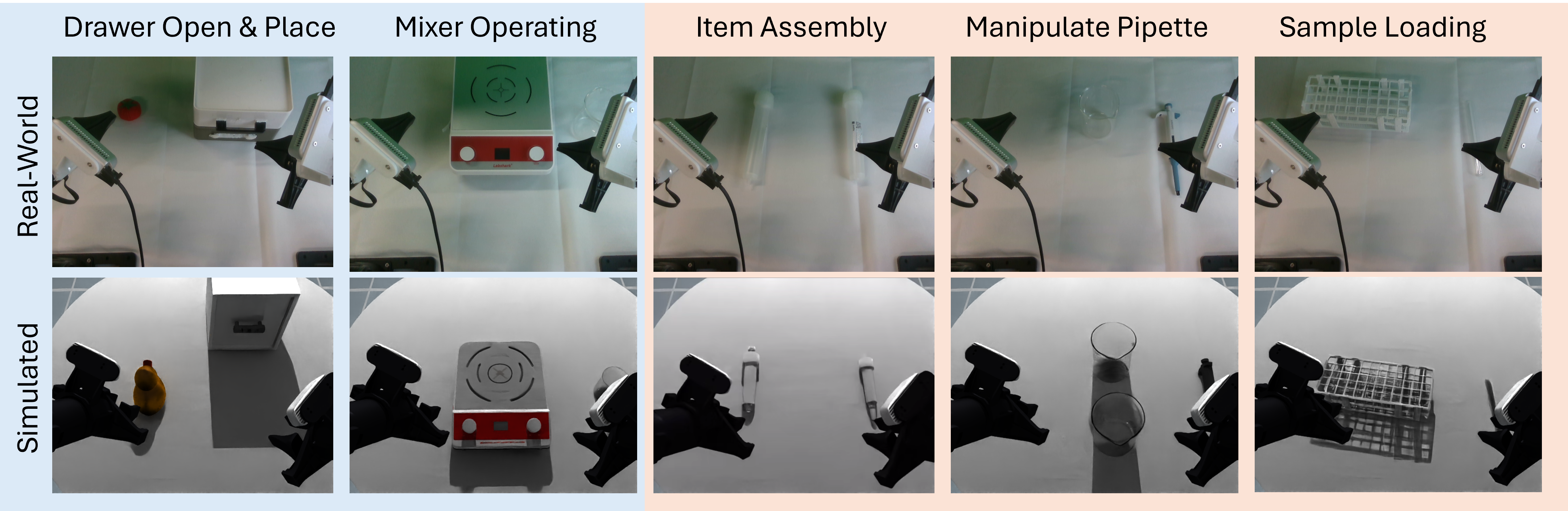
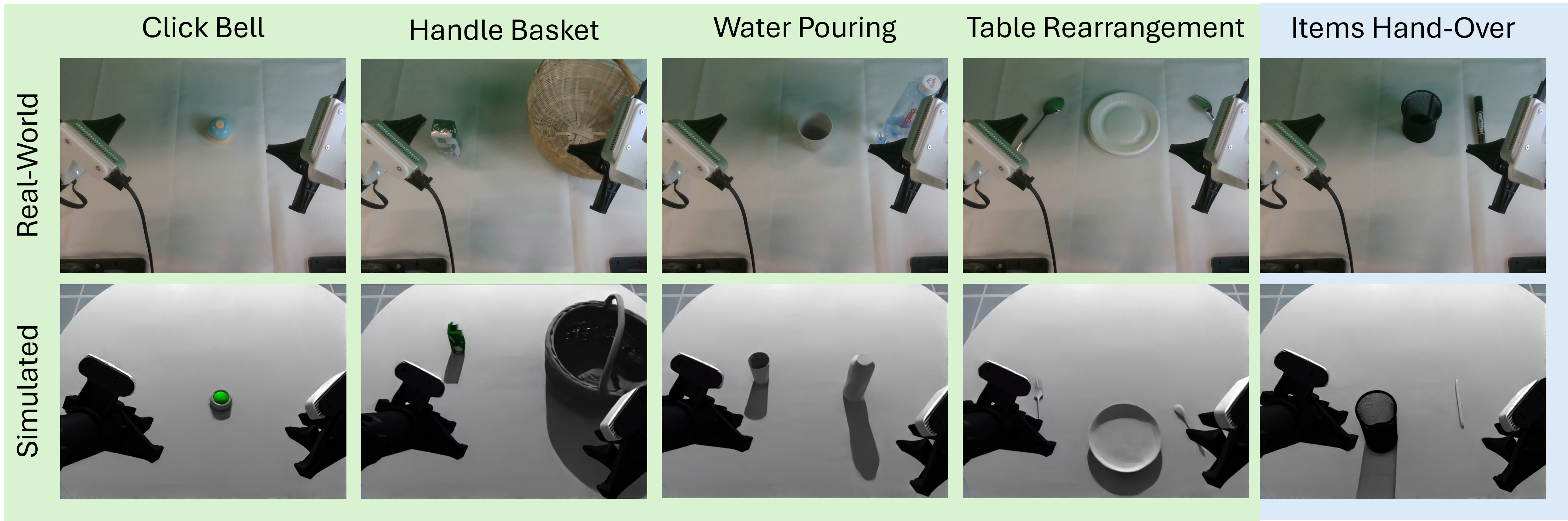
The competition features ten official bimanual manipulation tasks, structured to increase in operational complexity.
Entry-level tasks include:
• Table rearrangement
• Click-bell
• Dual-arm water pouring
• Basket pick-and-place
Mid-level tasks include:
• Items hand-over-and-place
• Drawer open-and-place
• Mixer operating
High-level tasks include:
• Item assembly
• Manipulate pipette
• Sample loading
Ranging from short-horizon operations with clear objectives to complex tasks requiring bimanual coordination, precise control, and multi-stage planning, these ten tasks gradually reveal model limitations in perception, control, coordination, generalization capability, and long-horizon execution.
The competition evaluates submitted policies across three core dimensions:
Success rate: The robot's ability to reliably complete assigned tasks.
Action steps: The efficiency of motion execution for completing tasks.
Inference time: The response efficiency of the policy during real-world execution.
Occasional success is insufficient; competitive solutions must balance robustness, execution efficiency, and deployment speed.
Data, Tools, Baselines, and Tutorial All Ready
To enable teams to focus on model and algorithm development, the competition provides a complete suite of resources:
1,000 simulation trajectories per task to support scalable training and data generation
60 real robot demonstrations per task to provide physical world grounding for policies
Data generation tools, simulation codebase, baseline models, and training tutorials
Documentation for integrating and submitting custom policies
Real-world data encompasses variations in background, lighting, distractors, position, and orientation; synthetic data expands the training distribution via procedural generation and domain randomization.
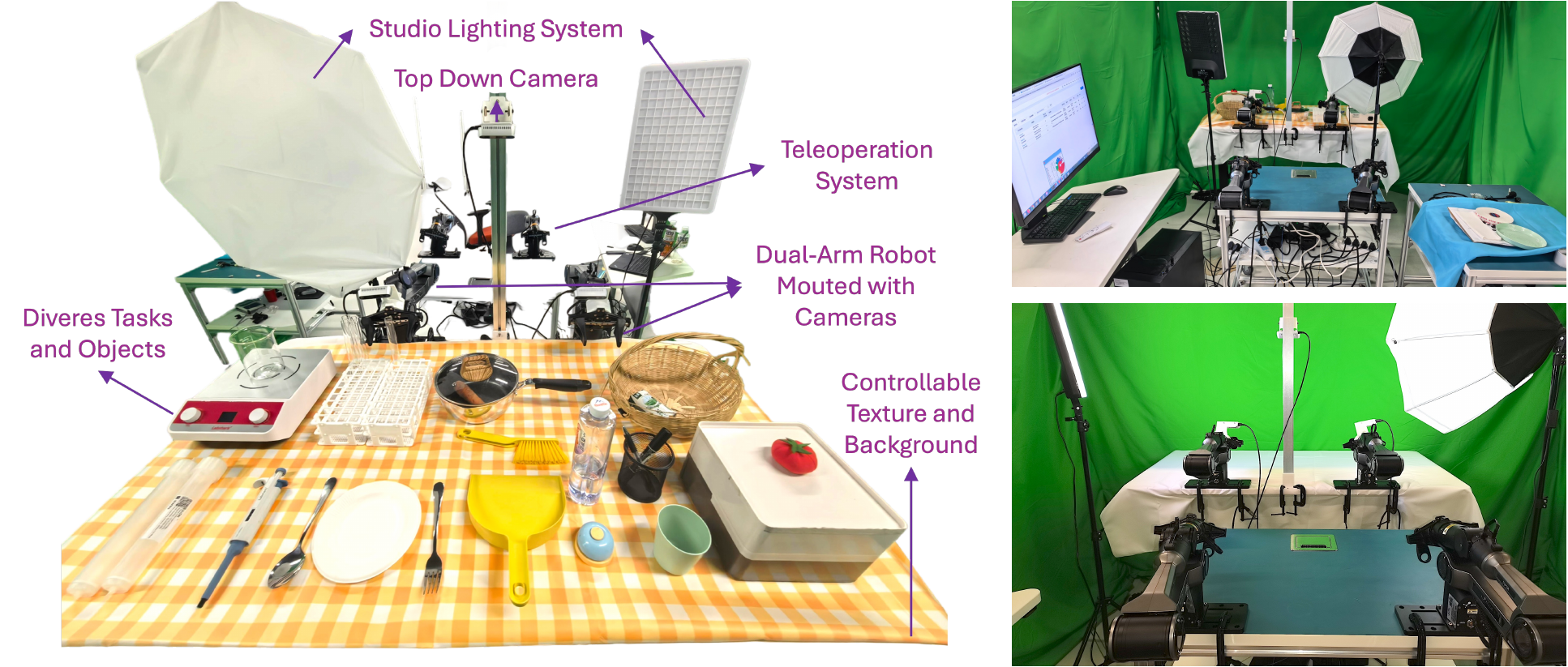
The official physical platform features bimanual robots, overhead cameras, lighting systems, teleoperation systems, and controllable backgrounds. Standardized hardware and environmental configurations minimize platform-specific confounders, ensuring that final results more purely reflect the generalization capability and deployment readiness of the policies themselves.
In other words, this is more than just a challenge that sets the problem without offering the tools. With the comprehensive resources provided, participants can quickly run through workflows using official baselines or pursue advanced research on data synthesis, joint training, policy architecture, and Sim2Real transfer.
Competition Timeline
• July 13
Registration opens, with the codebase, tutorial, datasets, and baselines released.
• July 13–October 11
Model training and optimization phase; registration remains open throughout this period.
• October 11–18
Models are evaluated in simulation; finalists are announced on October 18.
• October 18–November 15
Finalists continue updating models before the final submission deadline.
• From November 15
Final submissions are evaluated on the unified real dual-arm robot platform.
• Early December
Winning teams are invited to present and receive awards at NeurIPS 2026.
Total prize pool: USD 20,000
Prize distribution:
First Prize: USD 4,000 (1 team)
Second Prize: USD 2,000 (5 teams)
Third Prize: USD 1,000 (6 teams)
Total: USD 20,000
In addition to monetary awards, winning teams will receive certificates, media coverage, a showcase at NeurIPS 2026, and global exposure within the international robotics and AI community.
From Simulation to Real-World Deployment
RoboSynChallenge 2026 transcends a traditional competition.
It aims to establish a unified benchmark integrating synthetic data, limited real-world data, and physical generalization capability to enable standardized comparison of diverse data schemes, model architectures, and training methods.
For academic teams, this is a chance to push research boundaries and put their full pipeline to the test. For industry teams, it's a public proving ground for model generalization capability and real-world readiness.
Researchers working on robotic manipulation, VLA models, imitation learning, synthetic data, robot foundation models, or Sim2Real transfer are invited to participate in the challenge this summer.
The challenge is now underway, awaiting the policies that will make the leap from simulation to reality.
Registration and Competition Resources
Competition Homepage:
Registration Link:
https://robosyn-bench.net/#/register
GitHub Codebase:
https://github.com/EDEM-AI/RoboSynChallenge/tree/main
Datasets:
https://huggingface.co/RoboSynChallenge/datasets
Getting Started Tutorial:
https://edem-ai.github.io/RoboSynChallenge/html/getting_started/overview.html
Partners
Organizers
• Shenzhen Loop Area Institute & DexForce
Sponsors
• DexForce, Tencent Cloud & AgileX Robotics
Partner Institutions
• The Chinese University of Hong Kong, Shenzhen; The Chinese University of Hong Kong; The Hong Kong University of Science and Technology; Fudan University; Sun Yat-sen University; University of Waterloo; Vector Institute
Computing Support
• Computational Freedom
Media Partners
• Xbotics Embodied AI Lab & NICE