LIMA Center Team Wins ACL 2026 Outstanding Paper Awards
The 64th Annual Meeting of the Association for Computational Linguistics (ACL 2026) recently convened in San Diego, California. As the most influential top-tier international academic conference in natural language processing and computational linguistics, ACL gathers global frontier research and serves as a key platform for showcasing the latest theoretical breakthroughs and technological innovations in the field.
This year's conference set a new record, receiving 12,148 submissions to the main track with an acceptance rate of only 18.9%. At the awards ceremony, the paper "Hierarchical Acoustic-Semantic Modeling: Modality Separation and Semantic Coherence for Full-Duplex SLMs", led by Professors Haizhou Li, Min Zhang, and Baotian Hu from the Center for Language, Intelligence and Machines (the LIMA Center) at Shenzhen Loop Area Institute (SLAI), stood out and won the ACL 2026 Outstanding Paper Awards.
Only 18 papers were selected for this award, accounting for less than 0.2% of total submissions. This honor marks a milestone breakthrough for the LIMA Center in its strategic direction of full-duplex SLMs.
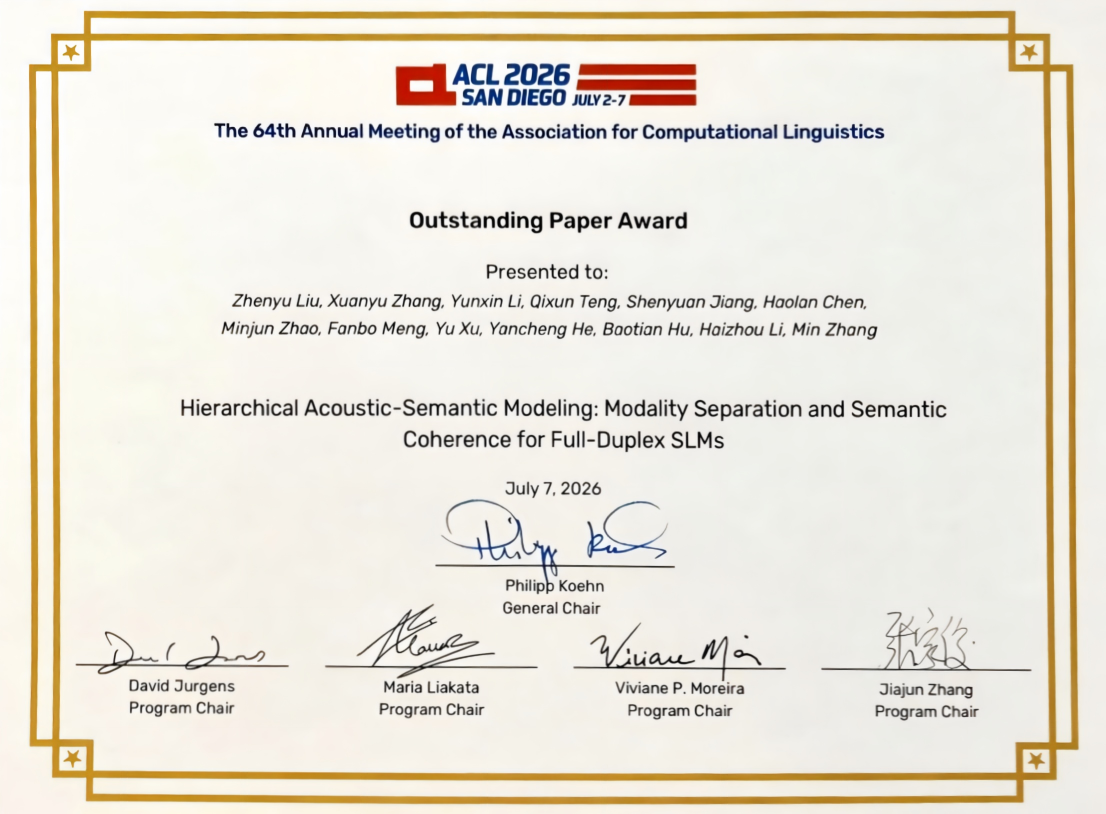
The research was undertaken by the LIMA Center in collaboration with The Chinese University of Hong Kong, Shenzhen (CUHK-Shenzhen), leveraging the computing resources and research infrastructure of SLAI's AI training platform. This achievement—led by first author Zhenyu Liu, a joint doctoral candidate of Harbin Institute of Technology, Shenzhen and SLAI—is a testament to the SLAI's robust capabilities in building high-level research platforms, advancing frontier AI research, and cultivating innovative talent.
01
About the Paper
Developing seamless, high-performance, native intelligent Full-Duplex Spoken Language Models (SLMs) has long been a core challenge in speech and natural language processing. Despite recent progress, existing models continue to suffer from a fundamental and intrinsic issue: modality interference. When acoustic and semantic modalities share deep parameter spaces, they trigger gradient conflicts that degrade model knowledge and semantic integrity, resulting in rigid and unnatural full-duplex interactions.
To address this, the team performed a fine-grained analysis of model optimization dynamics, systematically identifying the root cause of modality interference in full-duplex SLMs—a first in the field. They proposed Lychee-FD, a native end-to-end full-duplex framework. Its core innovation is a hierarchical parameter separation strategy that decouples conflicting modalities in deep networks while preserving cross-modal semantic consistency through dedicated semantic alignment channels.
Experimental results show significant gains across full-duplex benchmarks: Spoken question answering (Spoken QA) improved by 7.4%, and full-duplex interaction fluency (FullDuplexBench 1.5) rose by 28.5%, with no loss in inference efficiency. A review of the literature confirms that no prior study has simultaneously achieved both: revealing the internal mechanism of modality interference in full-duplex SLMs and proposing a clear, actionable hierarchical solution.
02
Demo Demonstrations
Video Demo 1: Simultaneous Listening and Speaking
Scenario: The model processes multi-party speech in real time during a user argument and responds instantly.
Video Demo 2: Real-Time Listening and Feedback
Scenario: An AI assistant listens to user concerns, organizes key information, and delivers immediate feedback.
Video Demo 3: Monologue with Intelligent Stop Detection
Scenario: An AI assistant tells a story to help the user fall asleep and automatically stops when sleep is detected.
03
Authors
Zhenyu Liu, Xuanyu Zhang, Yunxin Li, Qixun Teng, Shenyuan Jiang, Haolan Chen, Mingjun Zhao, Fanbo Meng, Yu Xu, Yancheng He, Baotian Hu, Haizhou Li, Min Zhang
Paper:
https://arxiv.org/abs/2607.06540
Code:
https://github.com/HITsz-TMG/Lychee-FD
Project Website:
https://hitsz-tmg.github.io/Lychee-FD
04
About ACL
Founded in 1962, the Association for Computational Linguistics (ACL) is the longest-standing and most influential international academic organization in natural language processing and computational linguistics, with members spanning 62 countries and regions. The annual ACL meeting is ranked as a Category A conference by the China Computer Federation (CCF) and is also recognized as a premier academic venue in the field, standing alongside NeurIPS and ICML as a top-tier platform for AI research.
The competition was fierce: ACL 2026 received 12,148 submissions, with a main track acceptance rate of about 18.9% and an outstanding paper award rate of just 0.15%. ACL award-winning papers often demonstrate strong potential for industrial application, with past recipients leaving a lasting impact on translation, speech, and large language models.
SLAI congratulates all authors and collaborators on this achievement.
The LIMA Center remains committed to advancing the next wave of full-duplex voice interaction.