
SLAI Advances AI for Social Science Through Three Flagship Projects in Economy, Finance, and Health
Deep integration of artificial intelligence with the social sciences involves both exploring how complex social systems operate and applying frontier technologies to enhance governance capabilities and improve public well-being. Based in the Hetao Shenzhen-Hong Kong Science and Technology Innovation Cooperation Zone, the Center for AI for Social Science at Shenzhen Loop Area Institute (SLAI) responds to strategic priorities and the practical development needs of the Greater Bay Area. Drawing on the advantages of Shenzhen-Hong Kong collaboration and a diverse range of application scenarios, the Center integrates research, talent development, and the exploration of real-world applications to develop a new research paradigm that uses AI to understand society, support decision-making, and serve the public.
On October 17, as SLAI marked its first anniversary, the Center presented three flagship projects at SLAI Nexus 2026, the Institute's innovation and collaboration conference. The first project uses multi-agent systems powered by large language models to create an economic "testing ground" for policy simulation and evaluation. The second explores cross-border financial AI governance by verifying regulatory sources across jurisdictions, reviewing transaction behavior, and tracing facts to their sources. The third incorporates lifestyle behavior, social support, and other nonmedical factors into chronic disease management, making health services more responsive to individual needs. Spanning economic activity, financial security, and public health, the three projects address a shared question: how can AI understand complex, real-world social systems and use that understanding to develop practical capabilities for supporting decisions, mitigating risks, and improving lives? Answering this question is central to moving AI for social science from academic exploration to social application.
PART 01 Simulating Policies in Twin Economies and Social Systems
[Project] Economic World Models: Foundations and Social and Market Simulation with LLM Agents
During the South Sea Bubble of 1720, scientist Isaac Newton traded shares in the South Sea Company. Although he initially sold at a profit, he later reinvested amid rising market exuberance and suffered heavy losses when the bubble burst. His widely quoted lament therefore seems especially thought-provoking: "I can calculate the motion of heavenly bodies, but not the madness of people." Even someone who could calculate the motion of heavenly bodies could not use the same methods to predict a market shaped by human expectations, emotions, and interactions.
A research team led by project head Lin William Cong, research leads Jiale Han and Benyou Wang, and Tao Shu, deputy director of the Center, is working to model this complexity. Its members include scholars and students Ye Luo, Jiguo Huang, Naixin Guo, Jing Qian, Yujie Cai, Fan Bu, and Luofeng Zhou. In collaboration with the Global Institute of Finance, Technology, and Society (GIFTS) at Nanyang Technological University, the team has combined scenario-specific foundation models with calibrated multi-agent simulation to develop the Economic World Models (EWM) for social and market simulation. The resulting models provide a generative environment that captures human economic psychology, economic behavior, and transitions between economic states. Building on first-generation EWM concepts such as AlphaPortfolio, AlphaManager, and data-driven generative equilibrium, the team has developed a series of multi-agent economic simulation systems, including WonderEcon and Qice Zhishu. Large language models (LLMs) with assigned personas make every microeconomic decision, including those concerning consumption, saving, borrowing, labor supply, production, pricing, investment portfolio allocation, bank rate setting, and fiscal transfer payments. Explicit rules govern institutional and market mechanisms, including tax schedules, interest rate corridors, market clearing, and double-entry bookkeeping. The economy's next state is therefore not predetermined. It emerges as tens of thousands of heterogeneous LLM agents respond to macroeconomic news, policy shocks, and one another's actions.
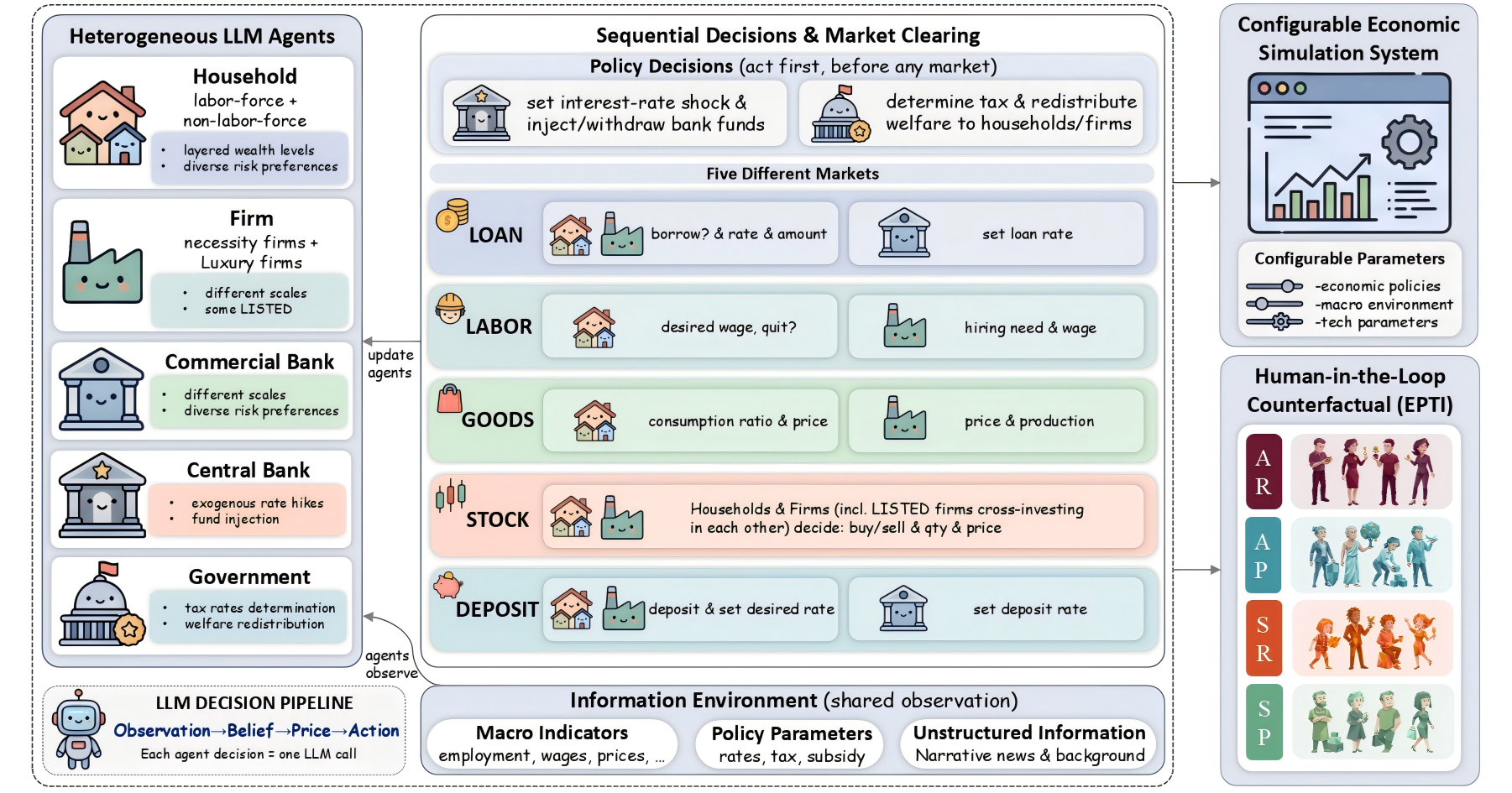
Overview of the WonderEcon economic simulation system
WonderEcon offers two complementary modes. In observer mode, users can configure the macroeconomic environment and, after running a simulation, replay agent decisions month by month and track economic dynamics. In player mode, a human user takes control of a household agent and makes economic decisions. The system compares these decisions with those of agents of the same type and generates a four-dimensional EPTI economic personality profile for the user.
The team aims to build on these capabilities to create an economic simulation platform with controllable conditions, reproducible results, and interpretable processes for policy evaluation, investment research, and financial education.
PART 02 Tracing Financial AI Risks From Rule Checking to Order Placement
[Project] Identifying Misinformation Risks and Building an AI Governance Framework for Cross-Border Finance in the Greater Bay Area
In a simulated A-share transaction, a large model correctly noted the rule capping price increases at 10% but still submitted an order to sell 900 shares at a simulated price of 118.10, above the permitted upper limit of 112.53. The execution engine rejected the order, and no shares were traded. The explanation was correct, so why was the action still wrong?
This question lies at the center of a project led by project head Yunya Song, guided by Lin William Cong, and conducted in partnership with The Hong Kong University of Science and Technology (HKUST). The research team also includes student members, such as Qijun Xie. Financial AI can be misleading in ways that go beyond fabricating facts. Authentic but inapplicable regulations, compliance statements that conflict with actions, and overlooked relationships can all affect judgment. Cross-border business also requires AI systems to distinguish among the rules of different jurisdictions.
A 2024 survey of the UK financial sector by the Bank of England and the Financial Conduct Authority received responses from 118 institutions, 75% of which were already using AI. When AI participates in business approvals, applying the wrong regulatory basis can result in an improper approval, while overlooking an applicable basis can lead to an unnecessary rejection. An erroneous order that is not intercepted may also cause financial losses. To address these risks, the team is pursuing three research directions: verifying regulatory bases, reviewing transaction behavior, and verifying facts across documents.
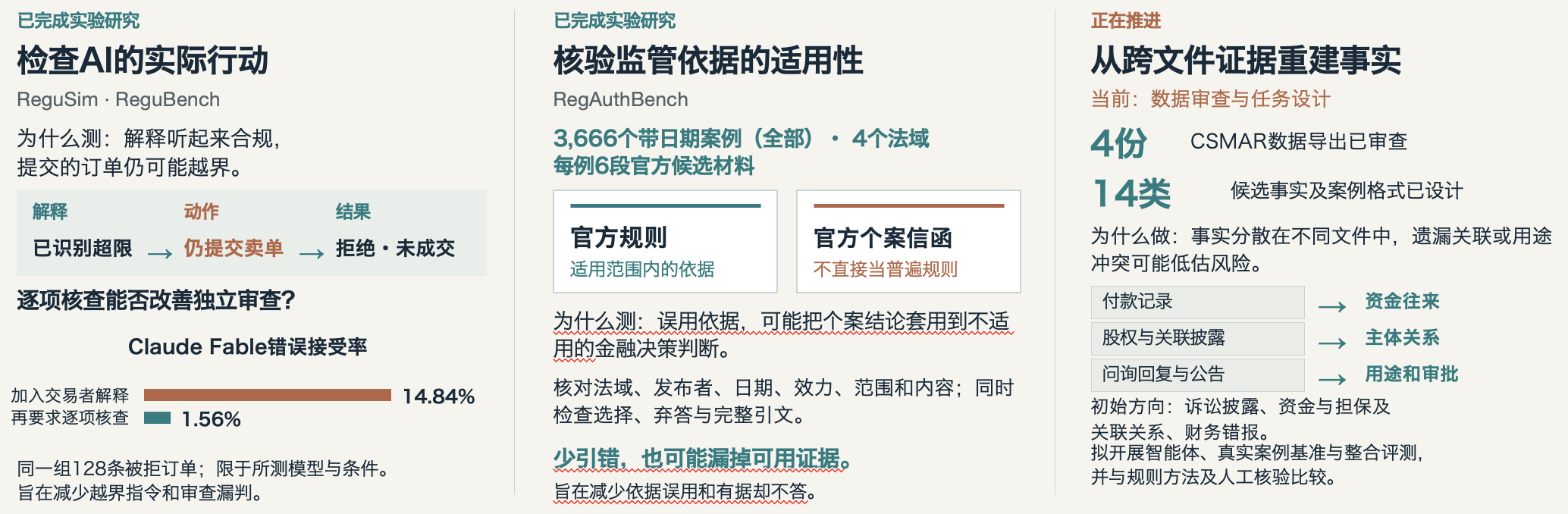
Three verification directions in research on cross-border financial AI regulation
RegAuthBench examines whether a regulatory basis applies to the question at hand. Both formal rules and official letters on individual cases may be relevant, but a conclusion reached in a specific case cannot simply be treated as a general rule. The benchmark contains 3,666 dated cases from four jurisdictions: the Chinese mainland, the Hong Kong Special Administrative Region, the European Union, and the United States. Each case provides six candidate passages from official sources. The benchmark evaluates six dimensions of applicability: jurisdiction; issuer; date and legal status; legal effect; scope; and support provided by the content. In 595 test cases, the team assessed evidence eligibility, the selection of a regulatory basis or abstention, and citation completeness. The results show that fewer citation errors do not guarantee correct judgments. A system may still omit usable evidence or decline to answer even when an applicable regulatory basis is available.
ReguSim asks large models to propose orders based on rules, objectives, and account states, while a fixed program checks the ledger and trading restrictions. For each order, the system separately records the model's explanation, its attempted action, and the execution outcome. This design prevents a rejected order from being mistaken for evidence that the model made no error and ensures that a rejected attempt is not described as a completed transaction.
The team also investigated whether assigning review to another model would identify errors. It selected 256 historical simulated orders, comprising 128 rejected orders and 128 accepted orders. When Claude Fable reviewed only the rules, account states, and orders, it incorrectly accepted eight rejected orders. After the traders' explanations were added, the number rose to 19. When the model was then asked to check each item individually, the number fell to two. These results reflect the model's review judgments under the tested conditions, suggesting that independent verification cannot simply restate a trader's rationale.
ReguBench uses independently generated synthetic records to evaluate models' ability to identify five patterns of market manipulation, including wash trading and spoofing, across 225 scenarios and 900 target records. When role cues were removed from account names while transactions and account relationships remained unchanged, the overall F1 detection scores of four models fell by approximately 8 to 18 percentage points. The results indicate that monitoring judgments can also be influenced by cues in account names.
In real-world financial services, relevant information is often dispersed across announcements, payment records, and related-party disclosures. Overlooking a single financial transaction or related-party guarantee can lead to an underestimation of risk. The team has therefore made cross-document fact verification part of its financial AI governance research. This work examines litigation disclosures, funds and guarantees, related-party relationships, and financial misstatements. It investigates how different documents corroborate one another and where conflicts or evidentiary gaps arise. By grounding judgments in traceable facts and evidence, this approach can help reveal risks that may not be apparent from any single document.
Together, these research efforts aim to make errors traceable, regulatory bases verifiable, and judgments independently reviewable. Through this work, the team seeks to establish independently testable governance capabilities for the safe application of financial AI in China. It has received funding from China Telecom Global and is collaborating with partner institutions, including the London School of Economics and Political Science (LSE), to establish an AI Observatory.
PART 03 Bringing Life Beyond Medical Records Into Chronic Disease Management
[Project] Social Computing-Enabled Full-Cycle Health Management for Chronic Diseases
Eat less salt, exercise more, and attend follow-up appointments on time. Such advice is easy to understand but not always easy to follow. People working shifts may struggle to exercise at regular times, older adults living far from medical facilities may find it difficult to attend appointments, and financial pressure can lead people to postpone examinations. In public health, these nonmedical factors are known as the "social determinants of health". Although rarely recorded in medical files, they have a tangible impact on chronic disease management.
To account for these factors, project head Hong Huang leads a research team under the guidance of the Center Director Lin William Cong and Ye Luo. Student members, including Jiaxiang Zhang and Zekun Chen, also participate in the research. Using social computing methods, the team analyzes lifestyle behavior, social support, financial pressure, and access to medical care alongside health monitoring data and medical records. It has developed a prototype for full-cycle chronic disease management in hospital settings.
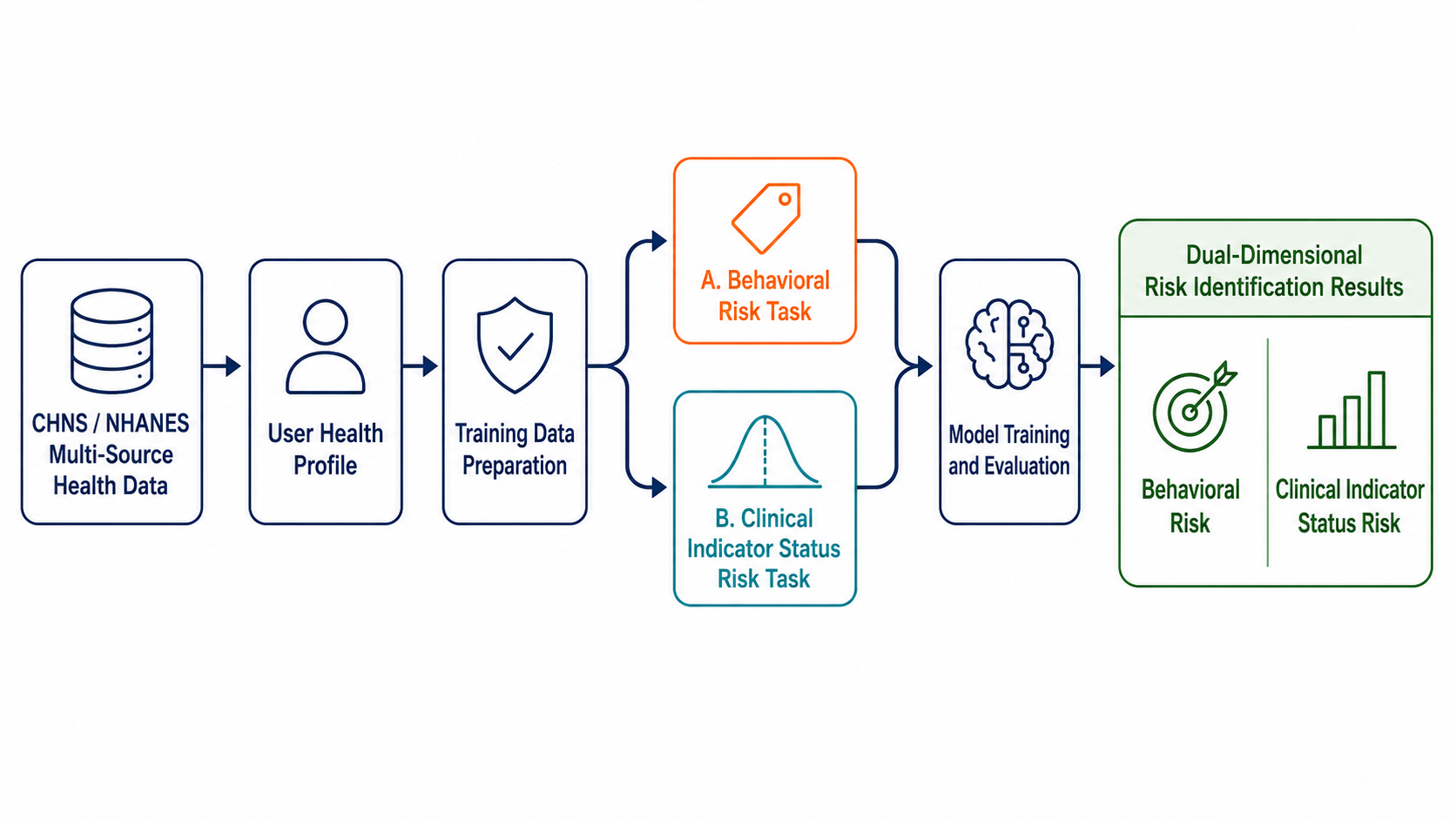
Two pathways for chronic disease risk identification
By design, the prototype centers on a locally deployed lightweight LLM agent. The agent brings together health records, clinical indicators, lifestyle information, and social attributes before calling multi-disease risk identification tools designed for 10 categories of chronic disease risk to assess the patient's risk. It then generates a personalized management plan based on the patient's support resources and practical barriers and updates the plan continuously using follow-up feedback.
Only the specialized tools generate risk scores; the LLM does not assign scores itself. Management recommendations draw on a clinical guideline knowledge base with traceable sources, and every plan must be reviewed by a physician. To date, initial training and evaluation of the risk identification component have been completed, and the clinical guideline knowledge base has been established.
EWMs simulate macroeconomic activity, an AI governance framework safeguards cross-border financial security, and a chronic disease management system supports patients throughout the care cycle. Although the three projects address different fields, they share a common academic thread: embedding AI agents in real-world social systems to simulate through understanding, govern through simulation, and serve through governance.
This shared approach reflects the founding mission of the Center for AI for Social Science. By addressing major strategic needs in frontier fields and the practical development needs of the Greater Bay Area, the Center works to advance the deep interdisciplinary integration of AI and the social sciences. Its goal is to turn frontier technologies into policy tools that can be evaluated, governance solutions that can be audited, and tangible improvements in public well-being.
Going forward, the Center will continue to advance its research in agent-based simulation, financial AI governance, and intelligent health, contributing Hetao's expertise to the development of trustworthy, controllable, and interpretable AI systems for the social sciences.