SLAI Launches SolarWM, First Streaming World Model Built on Domestic MiniMax-H3
Introduction
Can a single image become a world you can step into and explore? As a user moves forward or turns to look around, the AI model must render new frames in real time while keeping the surrounding environment consistent with what has already been generated. Achieving high definition, instant control response, and long-horizon stability at the same time has long been the central obstacle for interactive world models.
On September 13, 2026, a joint team led by Shenzhen Loop Area Institute (SLAI), together with The Chinese University of Hong Kong, Shenzhen, National University of Singapore, and other institutions, unveiled SolarWM-H3. The release marks the world's first streaming, few-step interactive world model built on MiniMax-H3, an advanced domestic video backbone, and covers the full pipeline from three-stage training to continuous interactive inference.
SolarWM-H3 is a 33-billion-parameter model that generates frames at a native 768P resolution in just four inference steps. It demonstrates robust zero-shot generalization across game environments and ranks first overall on both the Orbia and SANA-Bench public leaderboards. All training and inference code, stage-by-stage model weights, and industrial-grade companion datasets are released alongside, giving research teams an open foundation to reproduce the results, extend the training pipeline, and explore new applications.
A frame from the SolarWM launch video,
showcasing the project's overall capabilities and interactive effects across multiple scenarios
01 Four-Step Inference Keeps High-Definition Worlds Responsive in Real Time
If conventional video generation is like "writing the entire script before shooting the film in one take", an interactive world model is more like a director filming in real time: with every step forward and every turn, the scene must continue to unfold. In the conventional approach, the content is fixed first, and viewers wait for the complete clip; an interactive world model, by contrast, must keep accepting new actions as it generates and reshapes the frames that follow in response. When a user turns unexpectedly, it must both keep up with the action and stay anchored to the existing scene, continuously generating plausible spatial change.
Streaming autoregression enables the model to "generate while staying in step with the world". SolarWM-H3 adopts this approach: conditioned on the generation history and the current control input, it predicts subsequent frames chunk by chunk and feeds each new chunk into the next round of generation. With only four sampling steps per chunk, a large video backbone can sustain continuous interaction, while the native 768P resolution preserves rich visual details in buildings, vegetation, and characters.
In the team's testing, the H3 line marks a clear advance over the earlier SolarWM-5B, moving from "merely generating frames" to "sustaining generation under control", with markedly stronger camera handling and visual fidelity. Project demonstrations span forward motion, turns, and viewpoint switches across multiple settings, showing how a domestic video backbone can extend into interactive digital environments.
02 Free Exploration Starts from a Single Game Frame
In the latest demos, players can hike through snow-covered mountain forests, follow a waterfront boardwalk, or wander into stylized streets and courtyards. As the controls change, the characters keep moving and the viewpoint keeps shifting, while the world beyond the original frame gradually unfolds. Generative models are turning static game screenshots into spaces that can actually be explored.
These demos highlight SolarWM-H3's cross-game zero-shot interaction: rather than fine-tuning a separate model for each title, the same model transfers from familiar scenes to entirely new visual environments. Its ability to predict how a world changes across game boundaries is the most striking takeaway.
SolarWM-H3 interacting with games zero-shot,
with one model exploring multiple game styles and settings
For game developers and content creators, the model opens up new workflows for scene prototyping, interactive concept demos, and personalized world exploration. Starting from a single concept image, creators can navigate the space through continuous actions, evaluate the visual style and exploration experience early, and lay the groundwork for later gameplay and quest-system design.
03 SolarWM-H3 Tops Orbia and SANA-Bench Leaderboards
An explorable world must withstand one basic test: going out and coming back. Built around this question, Orbia comprises 720 evaluation cases across six types of exploration-and-revisit trajectories, including 480 short-range cases and 240 minute-scale extended cases. It measures whether a model can retain the input scene, remember newly generated content, and maintain 3D consistency across viewpoints.
As of October 9, 2026, SolarWM-H3 leads the public Orbia leaderboard with a score of 76.32, ahead of the 26 other world and video generation models on the list. Across the six evaluation dimensions, it ranks first in content persistence (70.28) and temporal stability (84.05), and second in control alignment (79.93).
If Orbia tests whether a model can leave and return, SANA-Bench tests whether image quality quietly erodes over time. In the team's latest evaluation, SolarWM-H3 also places first overall on SANA-Bench, which targets visual quality, revisit consistency, camera control, and temporal degradation in minute-scale generation and complements Orbia. Leading both benchmarks quantifies the model's sustained interactive capability: it follows movement and turning commands, continues previously generated environments upon revisit, and holds its performance as generation proceeds.
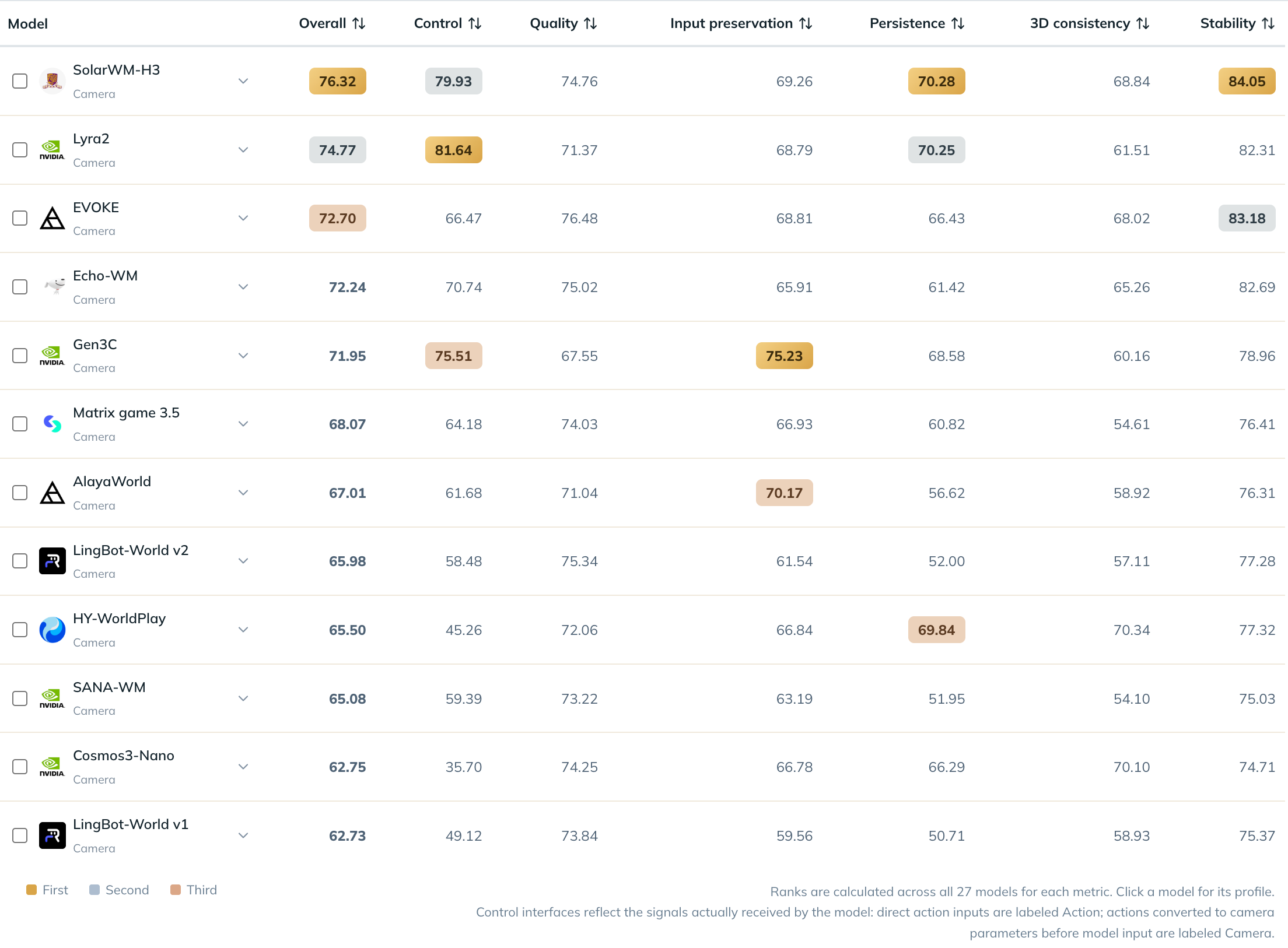
Results on the public Orbia leaderboard. Data as of October 9, 2026.
Source: orbia-bench.github.io. The full evaluation includes 27 models.
04 Three-Stage Training Unlocks the Domestic Video Backbone
Turning an advanced video model into a real-time interactive system means rethinking how it uses history, receives control signals, and predicts the future. The team structured this learning process into three connected stages, all fully open-sourced along the H3 line.
In Stage 0.5, the model learns camera control. While retaining its video generation ability, it associates camera motion with changes in the frame, laying the foundation for controlled generation.
In Stage 1, the model learns to predict what comes next from history. Training shifts from complete clips to causal generation, having the model predict new segments from existing frames and preparing it for few-step inference.
In Stage 2, the model learns to keep going on its own outputs. It trains on the history of its rolling generations and uses distribution matching distillation to improve few-step quality, closing the gap between training conditions and real interaction. The result is a streaming autoregressive model that samples in just four steps.
By releasing the code and weights for every stage, the team enables researchers to reproduce the entire training route or build on any single stage of it.
05 Open Industrial-Grade Data Ecosystem Powers Community Innovation
High-quality data fuels sustained world-model improvement. SolarWM has assembled a data ecosystem of roughly 1.43 million video clips totaling about 25 TB. Videos, camera trajectories, scene descriptions, and quality records are organized under a unified framework, with adjustable filtering rules and training recipes, so that real-world footage, synthetic environments, and game content can all enter the same research pipeline.
With the H3 release, the team also provides companion pre-encoded training data. Researchers can train directly on the processed representations, skip repetitive video encoding, and devote more effort to models and methods. Data-processing tools, annotations, and recipes are released as well, allowing the community to re-filter samples, rebalance data sources, and design new experiments.
As of October 9, 2026, SolarWM-Data has received download requests from 90 leading universities and research institutions worldwide, including the University of Oxford, Tsinghua University, Carnegie Mellon University, Peking University, Imperial College London, the National University of Singapore, The University of Hong Kong, Brown University, the University of Texas at Austin, the University of California San Diego, Nanyang Technological University, the University of Science and Technology of China, Zhejiang University, Shanghai Jiao Tong University, and Fudan University, as well as technology companies including NVIDIA, Adobe, Baidu, Meituan, Shopee, Horizon Robotics, KE Holdings, China Mobile, HiDream, and YoRoll. Downloads on Hugging Face and ModelScope have surpassed one million.
For SLAI and its partners, SolarWM-H3 matters not only because it pushes a domestic advanced video backbone toward sustained, controllable world generation, but also because it places the methods behind that capability into the community's hands. From generative gaming and interactive content creation to data research and training-method refinement, more teams can now build on these publicly released results, allowing world models to improve through real-world use and open collaboration.
Resources
Project Page:
https://junchao-cs.github.io/SolarWM-Web/
Open-source Code:
https://github.com/Junchao-cs/SolarWM
H3 Model Weights:
https://huggingface.co/junchaoh-cs/SolarWM-H3-33B
Pre-encoded Data:
https://github.com/Junchao-cs/SolarWM/blob/main/docs/latent-wds.md
Paper:
https://arxiv.org/abs/2609.02886
Orbia Leaderboard:
https://orbia-bench.github.io/
Research Team and Paper Information
Joint team: Shenzhen Loop Area Institute; The Chinese University of Hong Kong, Shenzhen; the National University of Singapore; The Chinese University of Hong Kong; The Hong Kong University of Science and Technology; The Hong Kong University of Science and Technology (Guangzhou); NVIDIA; the University of California, Los Angeles; Microsoft Research Asia
Paper: SolarWM: Open Data and Scalable Training for Long-Horizon Video World Models
Authors: Junchao Huang, Guian Fang, Shengju Qian, Xianghao Kong, Zhuoran Zhao, Wei Huang, Yihua Du, Zixin Zhang, Justin Cui, Yuchao Gu, Yukang Chen, Xinting Hu, Tianyu He, Shaoshuai Shi, Zhuotao Tian, Xin Wang, Mike Zheng Shou, Li Jiang
Corresponding author: Li Jiang
arXiv:https://arxiv.org/abs/2609.02886
Looking Ahead
SolarWM-H3 is only the beginning.
The team will continue refining long-horizon memory and finer-grained physical consistency, and bring interactive world models into real-world settings such as robotics simulation, virtual production, and digital twins.
The next chapter of the walkable world is being written together. All code, weights, and data entry points are publicly available, and researchers are invited to reproduce, improve, and co-build the interactive world-model ecosystem.