AI-powered Capability to "Simulate the Future" of Wireless Networks
In a city, many locations have never been truly measured.
Using only limited observations from real-world networks,
can AI infer these "unseen" wireless spaces?
Before constructing a base station
or setting a group of antenna parameters,
can AI predict the coverage and wireless environment
that will result from such changes to real-world networks?
These two questions
are becoming central to the evolution of next-generation network intelligence.
Recently, ChaRT (Chameleon Radio Transformer) was presented by a research team led by Prof. Tsung-Hui Chang from the Center for AI for Science and Engineering at the Shenzhen Loop Area Institute (SLAI), in collaboration with the Shenzhen Research Institute of Big Data (SRIBD), The Chinese University of Hong Kong, Shenzhen (CUHK-Shenzhen), Sun Yat-sen University (SYSU), and Huawei. Their related paper, titled "A Foundation Model for Large-Scale Wireless Network Planning, Operation and Optimization," has been published on arXiv.
According to the team's review, ChaRT is the first wireless foundation model pretrained and evaluated on real-world, city-scale operational measurement report (MR) data. Its aim is to empower AI not only to analyze "networks that have already been measured" but also to understand the underlying laws governing urban wireless environments — enabling it to fill in unobserved wireless spaces and predict potential network states following configuration changes.
What does the unmeasured wireless space look like?
How will the wireless environment change if network configurations are adjusted?
Core Highlights
● Trained on more than one billion operational MR samples
● Capable of extrapolation even with 80% data masking
● Deployed across 20 cities
● Achieved a 30% improvement in user experience for millions
01 Learning the Wireless World from Real-world Urban Networks
Modern urban mobile networks are complex systems shaped jointly by physical obstructions, road layouts, antenna configurations, frequency bands, user distribution, and multi-cell interference.
Traditional network planning and optimization often rely on drive tests, engineering experience, or ray tracing. While ray tracing provides strong physical interpretations, it requires detailed three-dimensional city models, material parameters, and extensive calibration. Conventional machine learning methods typically focus on specific tasks, and demand new data collection and model retraining when applied to different cities, frequency bands, or network challenges.
ChaRT adopts a novel pathway: learning wireless principles directly from real-world operational networks.
The model leverages MRs routinely generated by operational 5G networks for training, thereby eliminating the need for additional large-scale specialized measurements. In cities where it was pretrained, ChaRT uses more than one billion MR samples, comprising 18.2 billion beam-level observations from 3,503 cells operating at two major commercial frequencies.
To test whether the model merely "memorizes" specific cities or learns transferable wireless principles, evaluation also included cities and frequency bands beyond pretraining — covering 3,799 cells operating at three frequencies in three cities.
Thus, the significance of training on one billion MR samples lies not only in the large data volume, but more importantly, in enabling AI to develop a scalable wireless environment model that generalizes across diverse urban regions.
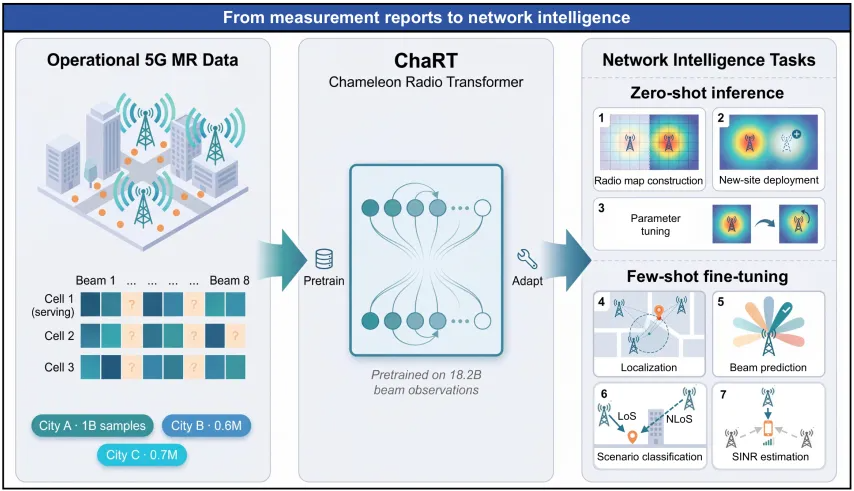
Figure 1 Architecture of ChaRT from operational MR data to network intelligence tasks
02 Capability One: Completing the "Unobserved Wireless Space"
Real-world network observations are inherently incomplete. Neither users are evenly distributed across city locations, nor can network measurements cover every spatial point. Some beams remain unobserved, and entire target cells may lack measurement data.
Traditional methods see wireless space full of such gaps. ChaRT, however, seeks to infer these unmeasured areas by leveraging observed signals from neighboring cells, base station configurations, and spatial relationships.
In cross-city zero-shot tests with up to 80% data masking, ChaRT achieves a beam-level mean absolute error (MAE) of 4.32 dB and a cell-level MAE of 5.61 dB, corresponding to reductions of 25% and 34% relative to XGBoost, respectively.
Previously, "How much signal was actually measured here?" was frequently asked. The question now shifts to "What would the signal look like here based on the entire network environment, even if unmeasured?"
Essentially, this capability reconstructs a more complete wireless space from sparse, localized real-network observations.
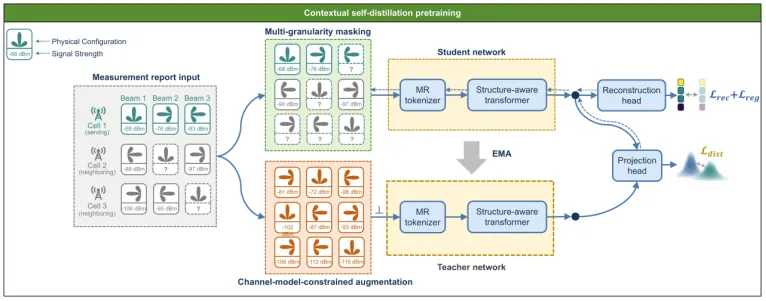
Figure 2 Contextual self-distillation pretraining combines multi-granularity masking with channel-model-constrained augmentation
03 Capability Two: Simulating Network Changes before Deciding on Real-world Implementation
Beyond inferring existing but unmeasured space, known as spatial completion, ChaRT can simulate network states that have not yet occurred in reality.
For example, before constructing a new base station, traditional methods rely on simulation or post-deployment verification to assess its coverage.
ChaRT treats all beams of a prospective base station as queries and, using only surrounding cell data and target site configurations, predicts the coverage that the yet-to-be-built station might provide. For greenfield new sites in City A, ChaRT achieves an R² of 0.55 and an MAE of 5.71 dB, compared with an R² of 0.28 for TabPFN v2. In a cross-city evaluation on newly deployed sites in City B, ChaRT achieves an R² of 0.62 and a beam-level MAE of 5.28 dB.
This approach also applies to network parameter tuning. What happens if mechanical azimuth, mechanical tilt, transmit power, electrical tilt, or beam codebooks change? Such parameters can be input as "hypothetical scenarios," allowing AI to simulate outcomes before actual deployment.
On real-world data from various parameter tuning rounds, ChaRT attains R² values of 0.60–0.80 across five parameter types, compared to 0.37–0.48 for the strongest baseline.
This opens a new possibility for network optimization: testing changes in the model first before applying them to the real network. Real-world networks do not always have to be the first testbed.
First change the network in the model, and then decide whether to change the real network.
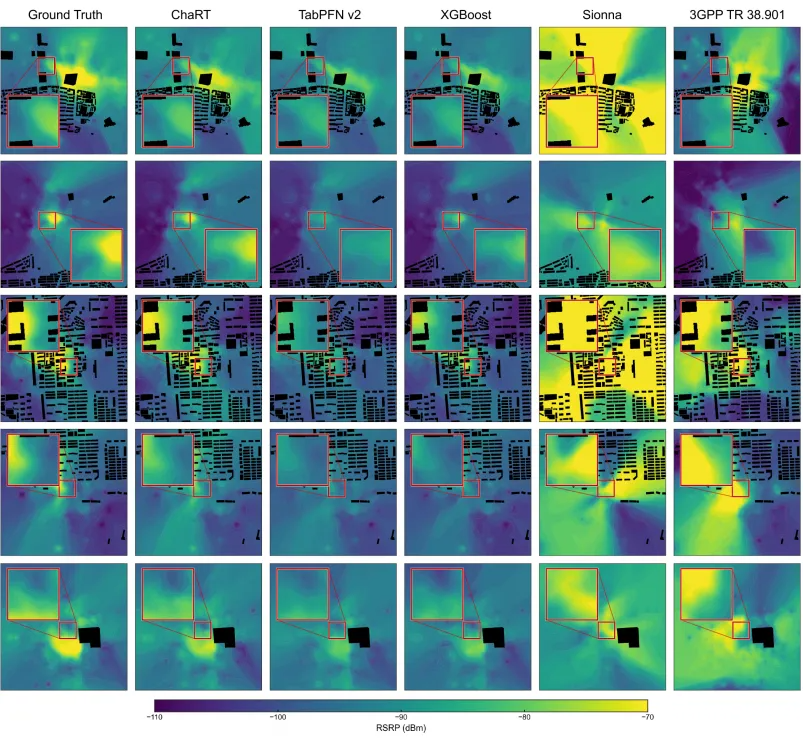
Figure 3 Cross-city new-site radio map comparison indicates ChaRT's coverage prediction closer to reality
04 Why does ChaRT Not "Scale the Transformer to the Wireless Network"
Simply feeding more data into a larger neural network is insufficient to truly learn the underlying laws of wireless transfer across cities and frequencies. ChaRT's core design embeds the physical structure of the wireless environment directly into the model.
Each wireless token in ChaRT represents not merely signal strength. Beam radiation pattern, relative cell location, transmit power, carrier wavelength, deployment attributes, together with RSRP, are jointly encoded, giving the model physically meaningful representations of beams rather than abstract identifiers.
The attention mechanism mirrors the hierarchical structure of wireless networks: The model first learns intra-cell beam relations, then aggregates beam data into cell representations, and finally captures inter-cell spatial dependencies. The mixture-of-experts (MoE) module guides, through diverse channel structures and dominant propagation directions, specialized experts to learn wireless structures with varying directionality and propagation characteristics.
In other words, wireless physics is more than a few input features attached to AI; it is integrated into the models representations, attention mechanisms, and expert assignments.
ChaRT aims to learn the structure of the wireless environment itself, not just task-specific experience.
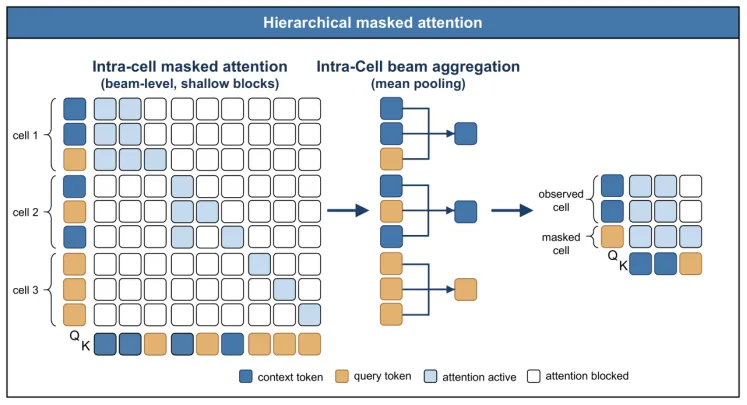
Figure 4 Hierarchical masked attention captures first intra-cell beam relations and then inter-cell spatial dependencies
05 From "One Model for One Task" to "One Model to Understand the Whole Network"
Traditional wireless AI is typically task-specific: separate models for radio map construction, new-site prediction, user localization, and beam prediction.
ChaRT tries to unify these scattered tasks within a single wireless environment representation. Radio map construction, new-site coverage prediction, and parameter tuning can be understood as different queries about the same wireless world under varying conditions.
For tasks such as user localization, beam prediction, propagation scenario classification, and signal-to-interference-plus-noise ratio (SINR) estimation, only lightweight task-specific heads are trained while the ChaRT backbone remains frozen. With just 1% labeled data from a target city, ChaRT reduces mean localization error from 111.0 meters to 62.9 meters, improves Top-1 beam prediction accuracy to 75.4%, achieves a macro-F1 of 83.0% for line-of-sight/non-line-of-sight classification, and lowers SINR estimation MAE to 2.48 dB.
This marks that AI is evolving from "one model trained specific to task" towards "one model forming a shared understanding of the entire network."
The shift embodies the true essence of a wireless foundation model.
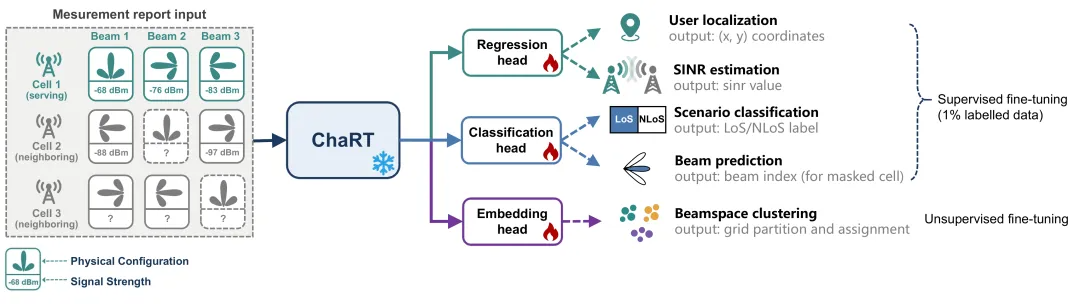
Figure 5 ChaRT adapts to diverse network tasks through training lightweight task-specific heads attached to the frozen backbone
06 From the Lab to Real-world Use: The Model Begins to Deliver Business Value
The true value of a wireless world model lies in its application to real-world networks. By 2026, ChaRT has been deployed in operational networks across 20 cities, including Shanghai, Changsha, and Nanjing, serving tens of millions of users.
Through continuous learning from real-world MR data, ChaRT predicts and evaluates changes in coverage effects and wireless environment before base station construction, antenna parameter tuning, and network scheme implementation. This supports intelligent decision-making in network planning, optimization and operation. Practice shows that ChaRT improves user network experience by 20%–30%, transitioning wireless networks from experience-dependent "ex-post optimization" to data-driven "ex-ante simulation."
Plans for 2027 include expansion into overseas markets such as Thailand and Indonesia. As city-scale wireless foundation models scale across diverse network environments, ChaRT is projected to generate RMB 600 million in revenue, continuously unlocking the commercial value of wireless network intelligence in operators' network construction, optimization, and operation.
Deployed in 20 cities, serving tens of millions of users From single-point trials to city-scale applications | Improving network experience by 20%–30% From "problem identification" to "ex-ante simulation" |
07 From Foundation Model to Wireless World Model
A world model's value extends beyond predicting "what will happen next." More importantly, it forms an internal representation of the environment to answer two questions: What parts have not yet been directly observed? How does the environment change under new conditions or actions?
ChaRT demonstrates some crucial capabilities of wireless world models: It can reconstruct unmeasured wireless spaces from limited observations, and perform counterfactual extrapolations for new wireless environments following changes such as new-site deployment and parameter tuning.
Thus, ChaRT represents more than a new wireless prediction algorithm. It is more noteworthy that ChaRT signals a broader transformation: Complex communication networks become real-world environments that AI can learn from, reconstruct, and extrapolate.
Just as robots require models to understand the physical world and autonomous vehicles need models to understand the road environment, future more self-reliant mobile networks will rely on models to comprehend their wireless world.
08 Letting AI Continuously Learn from Real-world Networks
ChaRT's tests reveal a noteworthy phenomenon: Benefits approach saturation as same-city data volume and model size increase. The next frontier goes beyond "large models" to expand data diversity across cities, operators, frequency bands, deployment configurations and incorporate information about temporal variations, service states, and building environments.
Real-world operational networks continuously generate new measurements and feedback. This creates a natural closed loop for continuous learning of wireless world models: data generation by real-world networks → model learning of wireless principles → model-driven scheme proposals → network execution → feedback to models.
As such models integrate further with network agents, optimization algorithms, and real-world feedback, AI's role will evolve from diagnosing "What's wrong with the network?" to predicting "What will happen if I make this change?"
Moving from observation to understanding and extrapolation, ChaRT is leading this transformation.
From observing wireless networks to understanding and extrapolating the wireless world
09 Joint Research Team and Paper Information
Joint Team: SLAI, SRIBD, CUHK-Shenzhen, SYSU, and Huawei
Paper title: A Foundation Model for Large-Scale Wireless Network Planning, Operation and Optimization
Author(s): Xinyu Qin、Wenqiang Pu、Hongcheng Dong、Bingsheng Peng、Ye Xue、Linzhi Shen、Qi Yan、Tsung-Hui Chang、Zhi-Quan Luo
Correspondence: Wenqiang Pu、Tsung-Hui Chang