AscendBridge 2.0 Expands from 321 to 500+ Models and Open-Sources Diffusers Text-to-Image Capability and Community Repositories
Lead
In April 2026, Shenzhen Loop Area Institute (SLAI) and Huawei open-sourced AscendBridge 2.0, creating an automated pipeline that streamlines model acquisition, code adaptation, error self-correction, precision alignment, performance optimization, and production validation. The initial release covered 321 mainstream models.
Two months later, this open-source ecosystem has scaled significantly.
The official AscendBridge 2.0 adaptation repository now includes 500 model adaptation packages, counting different weight variants of the same model separately. The models supported by these adaptation packages come from 68 different organizations, six major domains, and 24 subcategories. Simultaneously, a specialized repository for Diffusers text-to-image models has launched, offering adaptation packages for 9 mainstream models and 6 skills, covering the full workflow from migration and adaptation to performance optimization, batch generation, and quality evaluation. A third-party community adaptation repository also went live, allowing developers to freely find, reuse, and contribute new adaptations.
Scaling from 321 to 500+, AscendBridge 2.0 is building a sustainable, open-source ecosystem for Ascend-based model adaptation, integrating tools, official adaptation packages, vertical-specific adaptation packages, and community contributions.

The AscendBridge 2.0 ecosystem has expanded from 321 to over 500 packages, all directly searchable on GitCode.
01
Official Adaptation Repository Expands from 321 to 500+ Packages, Deepening Both Breadth and Utility
The newly released 500 model adaptation packages (including different weight variants for the same model) go beyond a simple roster. Each model includes an independent adaptation directory with run examples, dependency configurations, baseline precision evaluation scripts, performance optimization scripts, and production validation scripts. These can be downloaded and reused individually or integrated into AscendBridge 2.0 for unified orchestration.
Model distribution by type:
- Foundation language models (117): Covering general dialogue, code, mixture of experts (MoE), and preference alignment.
- Retrieval and natural language processing (117): Including embedding, reranker, text classification, and entity recognition.
- AI for Science and scientific computing (103): Covering biomedicine, proteins and genomics, materials and molecules, and geospatial scenarios.
- Multimodal and generative AI (58): Including vision-language, image generation, and video generation models.
- Computer vision and time series (55): Covering classification, detection, segmentation, OCR, depth estimation, and time series prediction.
- Speech and audio (50): Covering speech recognition, speech synthesis, vocoders, audio classification, and speaker recognition.
These are further divided into 24 subcategories. Notable clusters include: 92 general and dialogue large models, 73 text embedding and representation models, 56 biomedical and clinical NLP models, 32 vision-language models, 32 speech recognition models, 31 material and molecular prediction models, and 29 image classification and feature extraction models.
The models supported by these adaptation packages also come from an increasingly diverse range of developers and organizations. The 500 models come from 68 different teams and organizations, ranging from major industry players such as Qwen, Microsoft, Google, OpenAI, IBM Research, BAAI, and AllenAI to research groups including the Materials Informatics Laboratory and ClaRAN, as well as numerous community developers focused on low-resource languages, life sciences, materials science, and vertical industries.
All adaptation packages have completed migration, platform adaptation, baseline evaluation, performance optimization, and production validation. The accompanying metadata sheets detail model categories, evaluation data, quality metrics, and hardware comparison results, allowing developers to quickly search by model, task, or scenario and eliminating the need to build migration paths from scratch.

The 500 models cover six major domains, enabling quick location of adaptation packages via model names.
02
9 Model Adaptation Packages and 6 Skills Open-Sourced for Text-to-Image Capabilities
Building on the expansion of general model adaptations, AscendBridge 2.0 is advancing into key vertical domains. The first specialized focus is on text-to-image models that rely on the Hugging Face Diffusers library.
The SLAI project team has consolidated and open-sourced the SLAI-Diffusers-Adapter specialized capability repository. Designed for the Ascend 910C/NPU environment, it provides a one-stop, reusable workflow covering model migration, inference validation, performance tuning, and generation quality evaluation. Beyond storing adapted models, the repository encapsulates migration methods, processes, and optimization experiences into skills, enabling standardized adaptation for new models. It does not store model weights but retains truly reusable adaptation materials: NPU inference scripts, uv environment configurations, baseline and optimization speed test scripts, torch_npu patches, MS COCO image generation scripts, and quality evaluation records.
The first batch of 9 adapted models includes:
CogView4-6B, FLUX.1-dev, FLUX.2-dev, FLUX.2-klein-9B, GLM-Image, LongCat-Image, Qwen-Image, Z-Image, and stable-diffusion-3.5-large.
Text-to-image migration goes beyond simply generating images. The team designed an inference precision evaluation process around three dimensions: fidelity, diversity, and text-image alignment. The open-source repository preserves MS COCO generation scripts and Inception Score (IS) and Fréchet Inception Distance (FID) results for all 9 models. Evaluation metrics are recorded strictly according to official recommendations for resolution, inference steps, scheduler, and guidance scale, ensuring that low-cost speed test parameters are not conflated with quality evaluation parameters.
Building on SLAI's Diffusers model adaptation capabilities and packages, these achievements have already been adopted in scientific research. The "Lingjing Zaowu" platform, developed by the University of Science and Technology of China, has deployed the stable-diffusion-3.5-large model to support frontier research such as protein inverse design and spectral simulation. This marks a transition from running a demo to a stage where models can be called and reused by scientific platforms.
The repository also open-sources 6 skills in the migration/skills/ directory. The main pipeline includes:
- ascend-diffusers-migrate: Model analysis, memory management strategy, NPU baseline inference, and speed testing;
- ascend-diffusers-optimization: Diffusers fused kernels and environment tuning, with side-by-side comparison of baseline and optimized performance under identical conditions;
- ascend-diffusers-generation: Batch generation of approximately 5,000 evaluation images based on MS COCO prompts;
- ascend-diffusers-evaluation: Generation quality evaluation and result curation.
In addition, ascend-z-image-optimization curates compatibility fixes and specialized optimization practices for Z-Image on Ascend 910C, while torch-npu-optimization provides general fused kernel replacement methods for PyTorch models on NPU.
Integrated into the AscendBridge 2.0 toolchain, these six skills work in tandem to form a complete pipeline encompassing migration, adaptation, performance optimization, batch generation, and quality evaluation, delivering not only 9 adapted models but also a full migration methodology for new models.
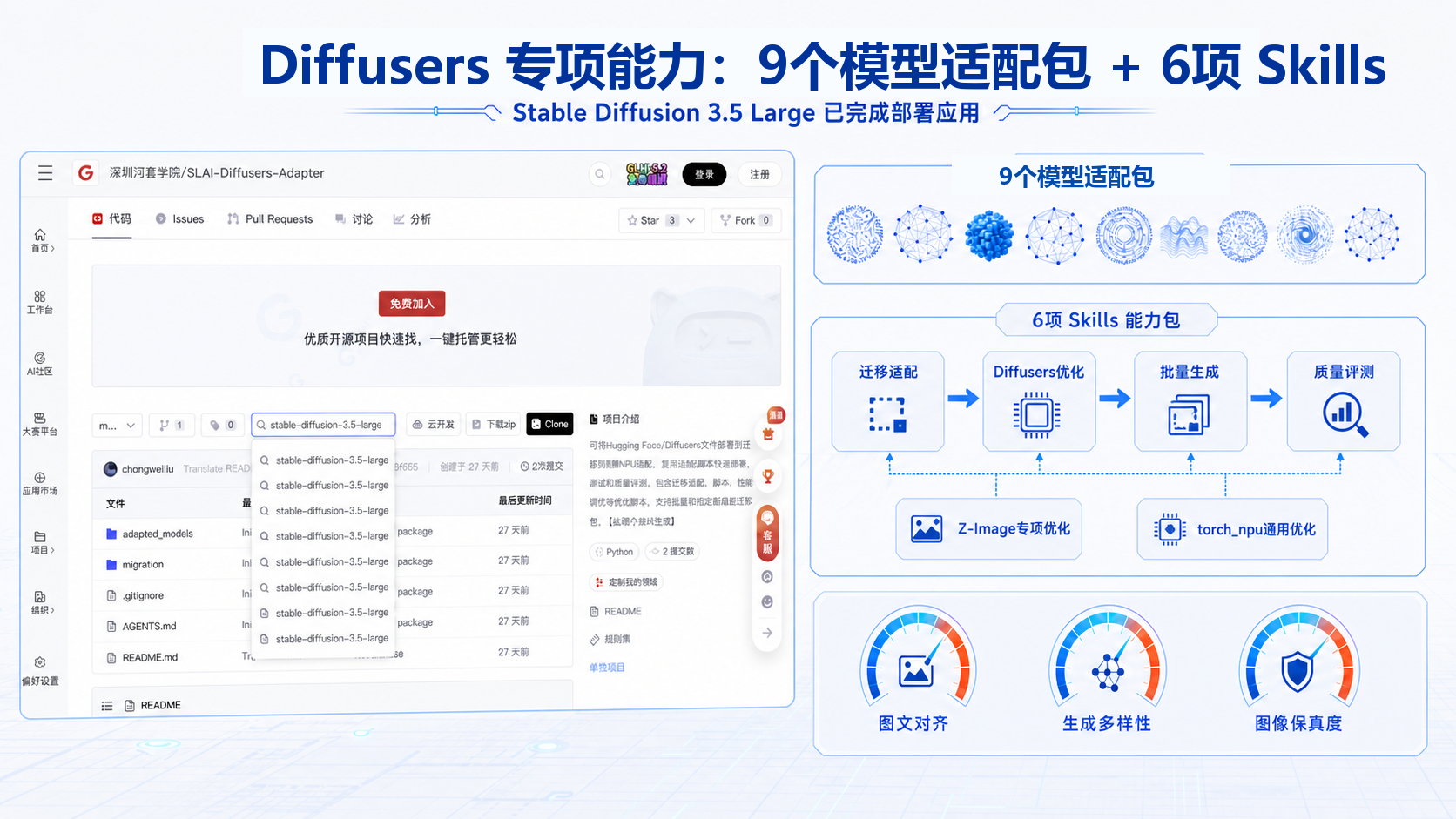
The specialized capability repository for Diffusers text-to-image models now offers 9 model adaptation packages and 6 skills, creating a complete workflow for migration, optimization, batch generation, and quality evaluation.
03
Community Adaptation Repository to Make Third-Party Contributions Searchable, Reusable, and Iterative
While the official adaptation repository handles large-scale releases and the specialized capability repository for Diffusers text-to-image models consolidates vertical-specific workflows, the SLAI-AscendBridge2-Community-Adaptations community adaptation repository focuses on third-party contributions. It centrally collects single-model adaptation materials that have been successfully run or verified by developers, making them searchable, reusable, and continuously improvable.
The community adaptation repository does not impose a fixed framework or store model weights. Instead, it archives reusable assets generated after each model adaptation, including documentation, sample code, validation scripts, and optimization records, making it easy for developers to quickly reference, directly reuse, and iteratively improve upon existing work.
To date, the repository has incorporated 22 model adaptation packages, covering large models, multimodal systems, text-to-image, vision detection, content security, and AI for Science. Representative models include:
- Instruction dialogue and multimodal models: Mistral-7B-Instruct, SmileyLlama, and S1-VL-32B-RL;
- Image editing and 3D generation: FLUX.1-Kontext-Dev, Z-Image-Turbo, and TRELLIS;
- Detection and content security: YOLO11m, SigLIP2, OpenNSFW2, ViT-NSFW, and multilingual toxicity classifiers;
- Scientific research applications: DetaNet, MACE, SchNetPack, REANN, DeepChem, Chemprop, PropMolFlow, MOFGPT, MatterChat, Perovskite-R1, and TranSpec—focusing on molecular property prediction, material generation, material Q&A, and spectral services.
The core value of the repository lies in transforming a one-off local adaptation by an individual developer into traceable, reusable public model adaptation packages. After completing a new model adaptation using AscendBridge 2.0, developers can submit their adaptation directories, documentation, demos, validation scripts, and optimization records to the community adaptation repository. Subsequent developers can then directly reuse or iterate on these materials when searching for a model.
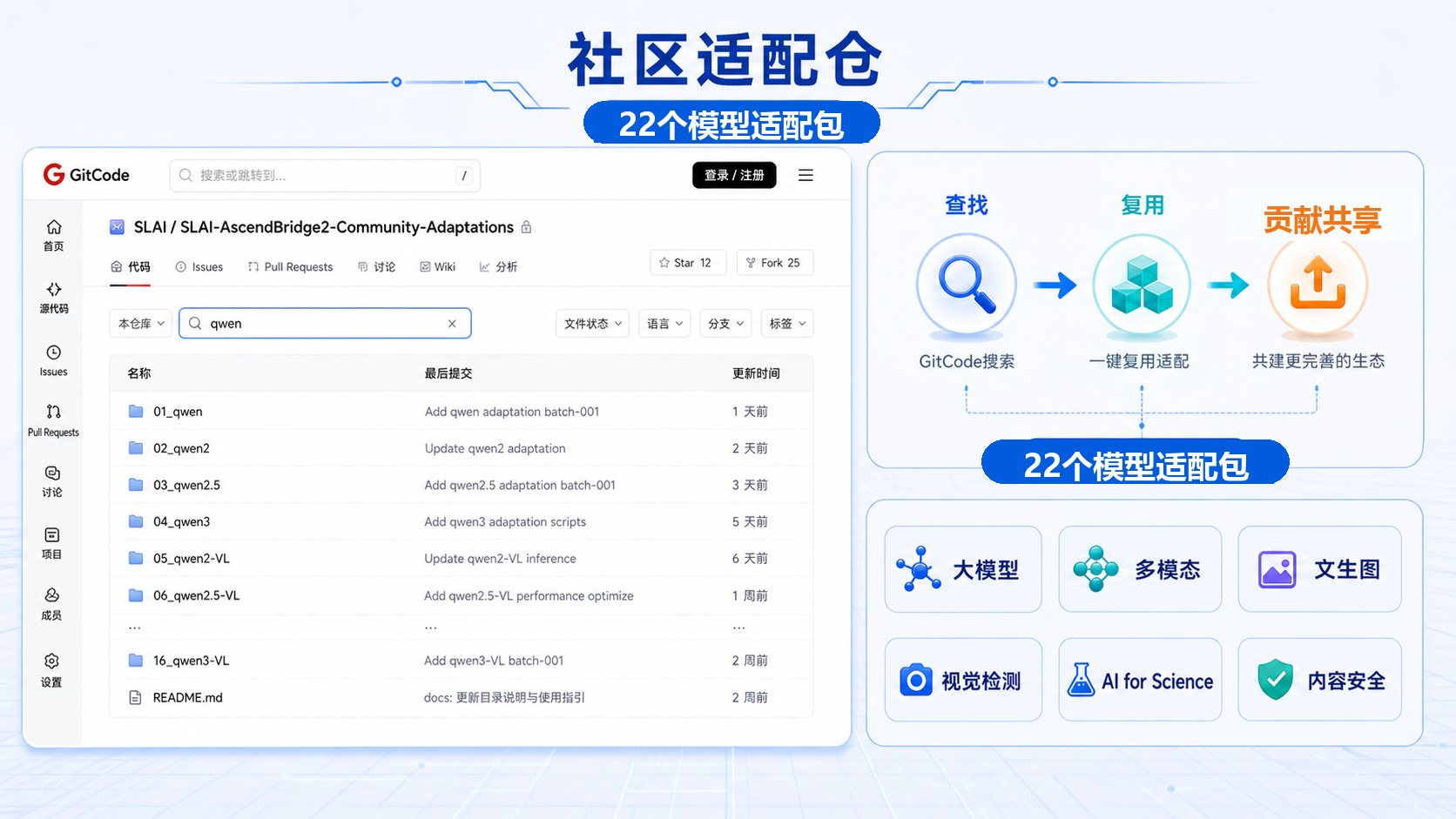
The community adaptation repository now hosts 22 model adaptation packages, enabling search, reuse, and shared contributions.
04
Three Repositories, One Sustainable Open-Source Pathway
With this update, the open-source offerings in AscendBridge 2.0 are now structured around four distinct parts:
1. Main repository (SLAI-AscendBridge 2.0): Provides toolchains for multi-agent collaboration, state management, adaptation, evaluation, and optimization;
2. Official adaptation repository (SLAI-AscendBridge2-Adaptations): Releases 500 verified model adaptation packages;
3. Specialized capability repository for Diffusers models (SLAI-Diffusers-Adapter): Consolidates 9 text-to-image model packages and 6 skills, covering migration, tuning, batch generation, and quality evaluation workflows;
4. Community adaptation repository (SLAI-AscendBridge2-Community-Adaptations): Hosts 22 community model adaptation packages, supporting search, reuse, and shared contributions.
For developers, if the target model is already in the official or community adaptation repository, scripts can be reused directly. For new Diffusers models, developers can start with specialized skills and standard directories. Upon completing a new adaptation, single-model directories can be submitted to the community adaptation repository to ensure a continuous flow of results.
The value of these tools hinges on reducing developer friction. The 500+ models offer broad coverage; the specialized capability repository for Diffusers text-to-image models provides vertical-specific packages and enables workflow reuse; and the community adaptation repository serves as an entry point for continuous expansion. Together, they transform model adaptation from one-off efforts into searchable, reproducible, and iterable public engineering resources.
05
Open-Source Repositories
AscendBridge 2.0 Main Repository:
https://gitcode.com/SLAI/SLAI-AscendBridge2
Official Adaptation Repository (500+ Models):
https://gitcode.com/SLAI/SLAI-AscendBridge2-Adaptations
Specialized Capability Repository for Diffusers Text-to-Image Models:
https://gitcode.com/SLAI/SLAI-Diffusers-Adapter
Community Adaptation Repository:
https://gitcode.com/SLAI/SLAI-AscendBridge2-Community-Adaptations
From open-sourcing tools to scaling model adaptation packages, and from vertical-specific workflows to community contribution mechanisms, AscendBridge 2.0 is turning dispersed know-how from Ascend-based model migration into reusable engineering capabilities. Going forward, the SLAI-Huawei project team will continue to expand adaptation packages for mainstream and key industry models, refine quality evaluation and community verification workflows, accelerate the onboarding of more models to the Ascend ecosystem, and ensure that every adaptation can be reused by subsequent developers.
Joint Release Organizations:
Shenzhen Loop Area Institute, Computing Platform Advance Team & Computing Product Line by Huawei