LIMA Center Team Tops Multiple Tracks at ACM MM 2026 Grand Challenges
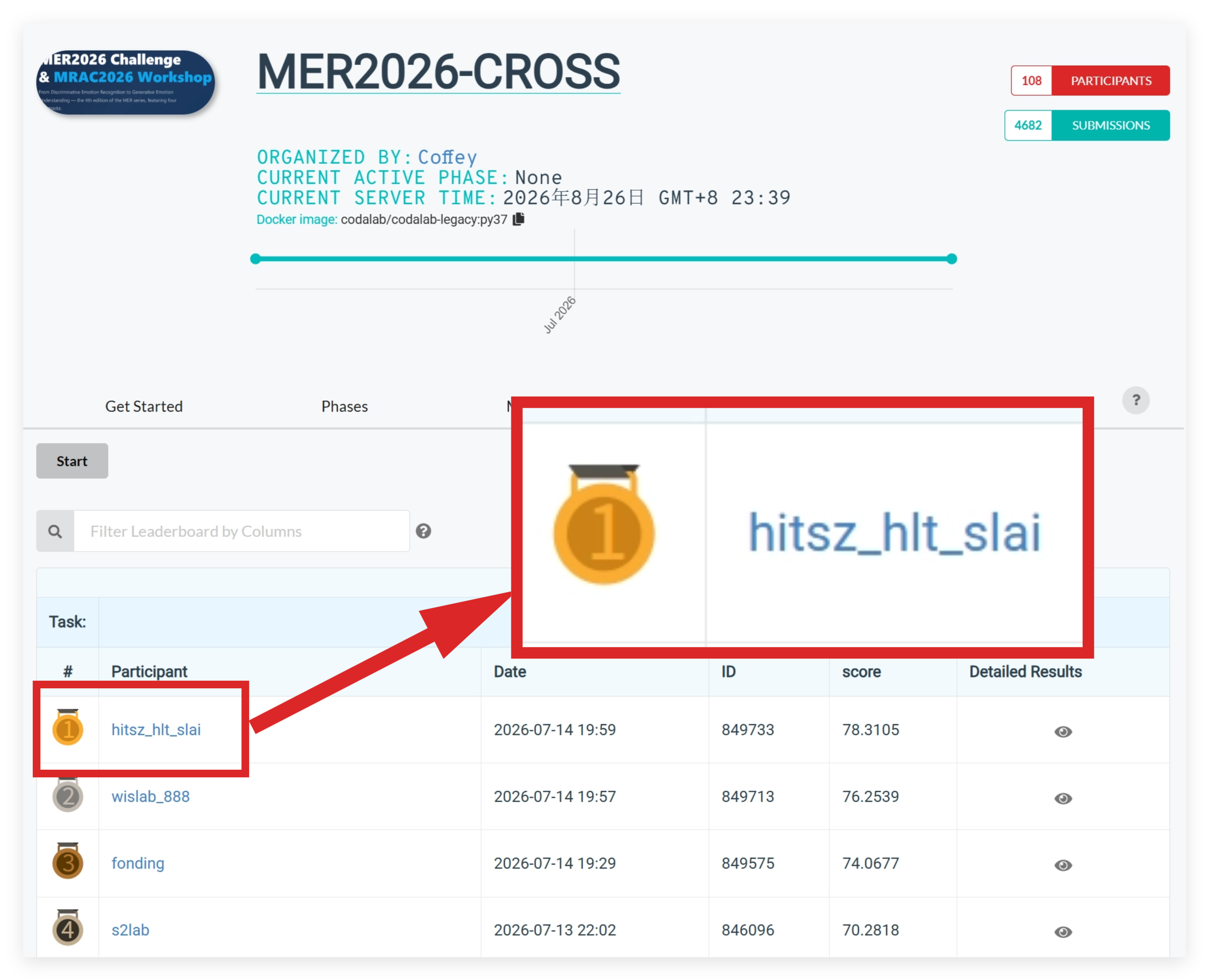
A joint research team led by Dual-Appointed Professor Ruifeng Xu from the Center for Language, Intelligence and Machines (LIMA Center) at Shenzhen Loop Area Institute (SLAI), has secured multiple top finishes at the ACM Multimedia 2026 Grand Challenges. The team, comprising research students from LIMA Center and Harbin Institute of Technology, Shenzhen (HIT Shenzhen), took first place in Track 1 and claimed the overall championship in the AdoDAS Challenge on multimodal adolescent depression, anxiety and stress assessment. The team also placed second in Track 2. In the MER2026 Multimodal Emotion Recognition Challenge, the joint team topped two tracks, taking first place in both MER-Cross and MER-Prefer.
01 AdoDAS Challenge: Intelligent Assessment for Youth Mental Health
The ACM MM AdoDAS (Multimodal Adolescent Depression, Anxiety, and Stress Assessment) Challenge centers on advancing scalable, reproducible, and comparable research in affective computing while maintaining privacy and ethical compliance. The competition featured a large-scale, privacy-protected multimodal dataset containing 24,000 audio-visual clips collected from 6,000 children and adolescents. It established two competition tracks: Track 1 requires binary screening across depression, anxiety, and stress (D/A/S) dimensions, while Track 2 focuses on predicting item-level responses for DASS-21 and reconstructing subscale scores.
The challenge attracted 193 teams worldwide, including participants from Tsinghua University, Peking University, Nanyang Technological University, The University of Melbourne, Ritsumeikan University, and The Chinese University of Hong Kong. The joint team, which included LIMA Center Ph.D. students Qiwei Lang, Bojun Jin and Yuzhe Liu, secured First Place in Track 1 (Multitask Binary Screening), Second Place in Track 2 (DASS-21 Item-Level Prediction), and the Grand Champion title for Overall Performance.
02 MER Challenge: Pioneering Listener Emotion Recognition and Preference Learning
The ACM MM MER (Multimodal Emotion Recognition) Challenge aims to foster deep integration between multimodal affective computing and human-computer interaction, enabling AI to interpret complex human emotional states with higher accuracy. Among the four tracks:
Track 1 (MER-Cross): Shifts the focus from the speaker to the listener. Instead of identifying the emotions of the person speaking, participating models were asked to predict the listener's emotional state during a conversation, capturing the emotional dynamics between both sides of an interaction.
Track 3 (MER-Prefer): Introduces human preference learning into emotional recognition. Given two emotional descriptions of the same video, models had to determine which description better aligned with human preferences. It is a crucial step for training affective understanding reward models. The track used a two-stage evaluation process, with final rankings based on average performance across two test sets, placing particular emphasis on the robustness of competing models.
A total of 304 teams participated in the MER challenge, representing universities including Tsinghua University, Peking University, New York University, National University of Singapore, The University of Sheffield, The University of Sydney, and The University of Hong Kong, as well as research teams from companies including Meta, Alibaba, JD.com, Meituan, and China Telecom. The joint team ultimately finished first in both MER-Cross and MER-Prefer.
03 Invited to Showcase Innovations at ACM MM 2026

Organized by ACM SIGMM (Special Interest Group in Multimedia), the ACM International Conference on Multimedia is a major international conference in multimedia computing and systems. ACM MM 2026 will be held in Rio de Janeiro, Brazil, from November 10 to 14, 2026. The winning joint team has been invited to present its technical papers and deliver oral presentations during the main conference program, sharing its latest breakthroughs with global peers.
04 Building on Academic Excellence for Future Innovations
These remarkable achievements highlight SLAI's long-term commitment to multimodal artificial intelligence and demonstrate the solid results of inter-institutional collaboration. They also underscore the LIMA Center's profound academic foundation in affective computing and its high-caliber talent cultivation capabilities.
Looking forward, SLAI will continue to focus on cutting-edge AI research, deepen the integration of industry, education, and research, and consistently produce high-impact, world-class achievements to drive the high-quality development of the regional AI industry.