预告 | SLAI Seminar第十三期
报告主题
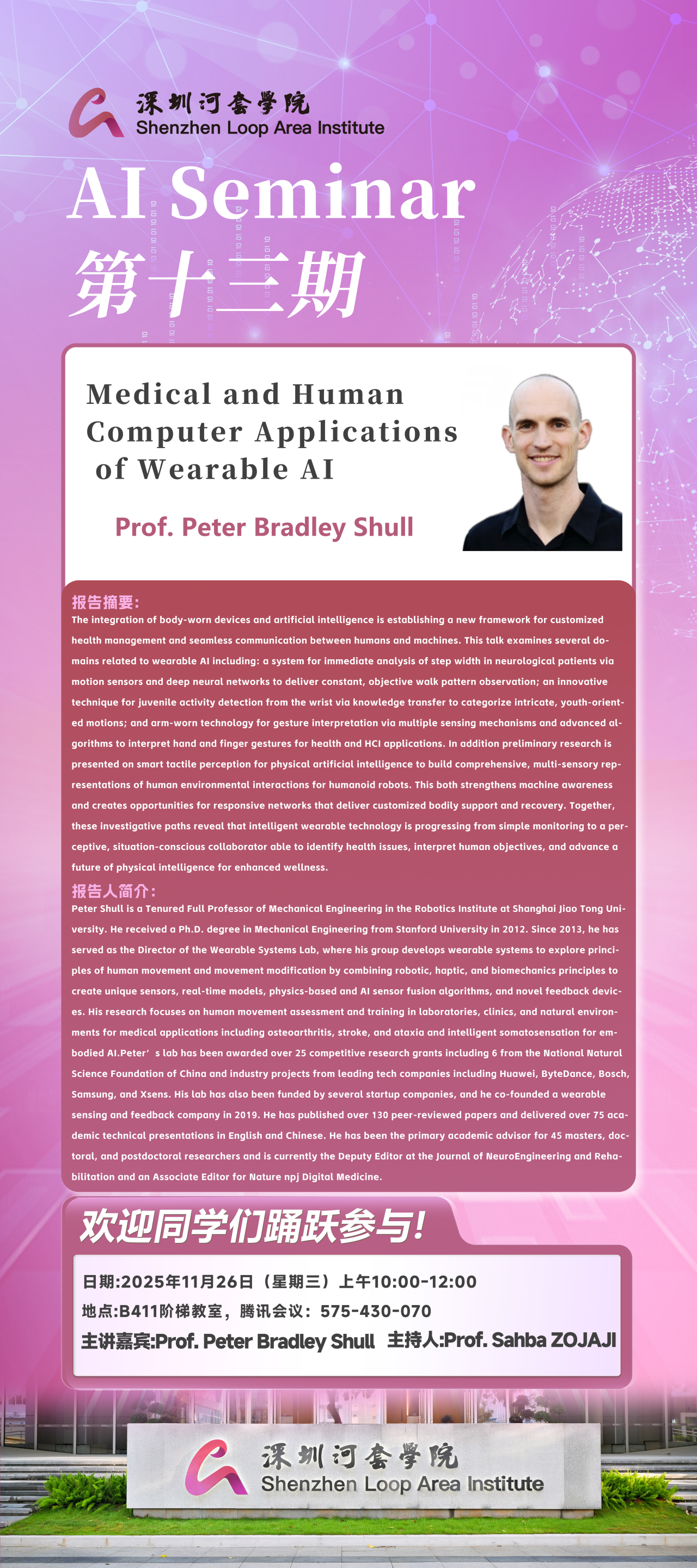
Medical and Human Computer Applications of Wearable AI
主讲嘉宾

Prof. Peter Bradley Shull
Peter Shull is a Tenured Full Professor of Mechanical Engineering in the Robotics Institute at Shanghai Jiao Tong University. He received a Ph.D. degree in Mechanical Engineering from Stanford University in 2012. Since 2013, he has served as the Director of the Wearable Systems Lab, where his group develops wearable systems to explore principles of human movement and movement modification by combining robotic, haptic, and biomechanics principles to create unique sensors, real-time models, physics-based and AI sensor fusion algorithms, and novel feedback devices. His research focuses on human movement assessment and training in laboratories, clinics, and natural environments for medical applications including osteoarthritis, stroke, and ataxia and intelligent somatosensation for embodied AI.
Peter’s lab has been awarded over 25 competitive research grants including 6 from the National Natural Science Foundation of China and industry projects from leading tech companies including Huawei, ByteDance, Bosch, Samsung, and Xsens. His lab has also been funded by several startup companies, and he co-founded a wearable sensing and feedback company in 2019. He has published over 130 peer-reviewed papers and delivered over 75 academic technical presentations in English and Chinese. He has been the primary academic advisor for 45 masters, doctoral, and postdoctoral researchers and is currently the Deputy Editor at the Journal of NeuroEngineering and Rehabilitation and an Associate Editor for Nature npj Digital Medicine.
报告摘要
The integration of body-worn devices and artificial intelligence is establishing a new framework for customized health management and seamless communication between humans and machines. This talk examines several domains related to wearable AI including: a system for immediate analysis of step width in neurological patients via motion sensors and deep neural networks to deliver constant, objective walk pattern observation; an innovative technique for juvenile activity detection from the wrist via knowledge transfer to categorize intricate, youth-oriented motions; and arm-worn technology for gesture interpretation via multiple sensing mechanisms and advanced algorithms to interpret hand and finger gestures for health and HCI applications.
In addition preliminary research is presented on smart tactile perception for physical artificial intelligence to build comprehensive, multi-sensory representations of human environmental interactions for humanoid robots. This both strengthens machine awareness and creates opportunities for responsive networks that deliver customized bodily support and recovery.
Together, these investigative paths reveal that intelligent wearable technology is progressing from simple monitoring to a perceptive, situation-conscious collaborator able to identify health issues, interpret human objectives, and advance a future of physical intelligence for enhanced wellness.
主持人
Prof. Sahba ZOJAJI
报告时间
2025年11月26日(星期三)
上午10:00-12:00
报告地点
深圳河套学院B411阶梯教室
(深圳市福田区福保街道红棉路6号,
地图导航“深圳河套学院-南门”)
线上链接
扫码加入会议

腾讯会议号:575-430-070